I'm not sure why a prosecutor should be able to retry a case after he couldn't convince a jury to convict. Isn't that reasonable doubt? To force someone to defend against two federal trials is impossible in every way -- financially and emotionally. The government had its shot in what was a controversial prosecution. Now time to go after a real criminal.

The SDFLA Blog is dedicated to providing news and notes regarding federal practice in the Southern District of Florida. The New Times calls the blog "the definitive source on South Florida's federal court system." All tips on court happenings are welcome and will remain anonymous. Please email David Markus at dmarkus@markuslaw.com
Monday, September 19, 2011
Mistrial in 4 month long mortgage fraud trial
This was trial #2 in the cop mortgage fraud trial, where trial #1 resulted in 4 of the 6 defendants being acquitted. For the second group of defendants, the jury hung, and I'm told it was 10-2 for acquittal. I feel for Judge Cohn, the defendants, their lawyers, and the prosecutors. This was an excruciatingly long trial. Is the government going to retry these defendants? As I've said before, I don't think retrials in cases like these are appropriate:

11th Circuit decides Padilla case 2-1
Here is the opinion .
Judge Dubina writes the majority, which Judge Pryor joins, affirming the conviction and reversing Jose Padilla's 17 year sentence as too low. Judge Barkett dissents on both the conviction and sentencing holdings. In total, there are 120 pages of opinions. This case seems destined for Supreme Court review.
More to follow...
Judge Dubina writes the majority, which Judge Pryor joins, affirming the conviction and reversing Jose Padilla's 17 year sentence as too low. Judge Barkett dissents on both the conviction and sentencing holdings. In total, there are 120 pages of opinions. This case seems destined for Supreme Court review.
More to follow...
Friday, September 16, 2011
BREAKING -- Rumors regarding district judge openings UPDATE -- Rumors confirmed!
Well, this wouldn't be printed if it were a newspaper or a legitimate publication, but because this is a blog, and I trust my sources, I am going to post the rumor that is being whispered about around town. Again, this isn't confirmed, but if it's being discussed at La Loggia, it can be discussed here too.
As we all know, 4 names were sent up by the JNC to fill Judge Gold's seat. Apparently, the White House is vetting two of those names, John Thornton and Robin Rosenbaum -- one to fill Judge Gold's seat and one to fill Judge Jordan's seat (see below; his confirmation hearing is next week).
If the rumor is true, congrats to Judges Thornton and Rosenbaum!
If anyone out there can confirm or refute this rumor, please email me and it will remain anonymous. Thanks.
UPDATED -- It's confirmed. Congratulations to Judge Thornton and Judge Rosenbaum! Here's hoping that the President and Senate move quickly.
As we all know, 4 names were sent up by the JNC to fill Judge Gold's seat. Apparently, the White House is vetting two of those names, John Thornton and Robin Rosenbaum -- one to fill Judge Gold's seat and one to fill Judge Jordan's seat (see below; his confirmation hearing is next week).
If the rumor is true, congrats to Judges Thornton and Rosenbaum!
If anyone out there can confirm or refute this rumor, please email me and it will remain anonymous. Thanks.
UPDATED -- It's confirmed. Congratulations to Judge Thornton and Judge Rosenbaum! Here's hoping that the President and Senate move quickly.
Judge Jordan's confirmation hearing next week
It's set for Tuesday, September 20. That was quick -- Well done to the adminsitration for moving this nomination forward. After his hearing, then he will get written questions from the committee and then there will be a vote. Looks like Judge Jordan may be on the 11th by sometime in November.
Now we need to get Bob Scola confirmed. He is #19 on the list of district judges waiting confirmation, so if they do a few per week, we are looking at October for Judge Scola.
Things are starting to move, which is nice.
Big shout out to Dore Louis for his posting over the past two days. Good stuff.
Now we need to get Bob Scola confirmed. He is #19 on the list of district judges waiting confirmation, so if they do a few per week, we are looking at October for Judge Scola.
Things are starting to move, which is nice.
Big shout out to Dore Louis for his posting over the past two days. Good stuff.
Thursday, September 15, 2011
Great Ruling on Strange Issue
By guest blogger, Dore Louis
Judge Cooke has just issued an Order in an interesting matter.
In July of this year, Governor Scott signed into law Fla. Stat. § 790.338, which contained a few odd provisions. Basically, the statute provided a basis to impose sanctions upon a doctor or health care provider who asks a patient about gun ownership or otherwise discriminates against a patient because of gun ownership.
"According to the State’s legislative findings, the State passed the law in reaction to an incident in Ocala, Florida, where a physician advised the mother of a minor patient that she had thirty days to find a new pediatrician after the mother refused to answer questions about firearms in her home."
Governor Scott is our Tea Party Governor. Big free market ideas...'let the market sort it out, government shouldn't be telling us what to do, etc.'; so it seems odd to me that he would sign into law a regulation that mandates a physician treat a patient who that physician does not want to treat because he/she owns a gun. Free market theory would instruct that if there are enough gun owners in the marketplace, the physician will either change his/her ways or go out of business.
Turns out the reason the pediatrician was doing what he/she did, was because the American Academy of Pediatrics counsels physicians to give guidance on gun safety. We don't want kids like this walking around, no matter how cute they are.

But why should politics make sense? Thankfully, Judge Cooke is able, through her thoughtful order, to make sense of subjects I was not particularly good at in Law School - First Amendment and Preliminary Injunction Law. What are those standards?
"At issue in this litigation is a law directed at maintaining patients’ privacy rights regarding firearm ownership within the context of the doctor-patient relationship. In effect, however, the law curtails practitioners’ ability to inquire about whether patients own firearms and burdens their ability to deliver a firearm safety message to patients, under certain circumstances. The Firearm Owners’ Privacy Act thus implicates practitioners’ First Amendment rights of free speech. The Act also implicates patients’ freedom to receive information about firearm safety, which the First Amendment protects."
...
"The State has attempted to inveigle this Court to cast this matter as a Second Amendment case. Despite the State’s insistence that the right to “keep arms” is the primary constitutional right at issue in this litigation, a plain reading of the statute reveals that this law in no way affects such rights. The right to keep arms refers to the right to “retain,” “to have in custody,” and “to hold” weapons, including firearms."
...
"I will not speak to the wisdom of the legislation now before me. Questions of a law’s constitutionality do not create “a license for courts to judge the wisdom, fairness, or logic of legislative choices.” FCC v. Beach Commc’ns, Inc., 508 U.S. 307, 313 (1993). The First Amendment, however, “was not designed to facilitate legislation,” whether wise or not. FEC v. Wis. Right to Life, Inc., 551 U.S. 449, 503 (2007) (Scalia, J., concurring). Based on the foregoing, I find that Plaintiffs have a substantial likelihood of succeeding on the merits of their constitutional challenge."
...
"Each of the factors for a preliminary injunction weighs in Plaintiffs’ favor. For that reason, the Plaintiffs’ Motion for Preliminary Injunction (ECF No. 16) is GRANTED. The State is preliminarily enjoined from enforcing § 790.338(1), (2), (5), and (6). The State is also preliminarily enjoined from enforcing § 790.338(8), to the extent that it provides that violations of § 790.338(1) and (2) constitute grounds for disciplinary action. The State is further preliminarily enjoined from enforcing § 456.072(1)(mm), to the extent that it provides that violations of § 790.338(1), (2), (5), and (6) shall constitute grounds for which disciplinary actions specified under § 456.072(2) may be taken."
I am a bit saddened that there were no Yosemite Sam references. Here is the Order.
Wollschlaeger Order
Judge Cooke has just issued an Order in an interesting matter.
In July of this year, Governor Scott signed into law Fla. Stat. § 790.338, which contained a few odd provisions. Basically, the statute provided a basis to impose sanctions upon a doctor or health care provider who asks a patient about gun ownership or otherwise discriminates against a patient because of gun ownership.
"According to the State’s legislative findings, the State passed the law in reaction to an incident in Ocala, Florida, where a physician advised the mother of a minor patient that she had thirty days to find a new pediatrician after the mother refused to answer questions about firearms in her home."
Governor Scott is our Tea Party Governor. Big free market ideas...'let the market sort it out, government shouldn't be telling us what to do, etc.'; so it seems odd to me that he would sign into law a regulation that mandates a physician treat a patient who that physician does not want to treat because he/she owns a gun. Free market theory would instruct that if there are enough gun owners in the marketplace, the physician will either change his/her ways or go out of business.
Turns out the reason the pediatrician was doing what he/she did, was because the American Academy of Pediatrics counsels physicians to give guidance on gun safety. We don't want kids like this walking around, no matter how cute they are.

But why should politics make sense? Thankfully, Judge Cooke is able, through her thoughtful order, to make sense of subjects I was not particularly good at in Law School - First Amendment and Preliminary Injunction Law. What are those standards?
"At issue in this litigation is a law directed at maintaining patients’ privacy rights regarding firearm ownership within the context of the doctor-patient relationship. In effect, however, the law curtails practitioners’ ability to inquire about whether patients own firearms and burdens their ability to deliver a firearm safety message to patients, under certain circumstances. The Firearm Owners’ Privacy Act thus implicates practitioners’ First Amendment rights of free speech. The Act also implicates patients’ freedom to receive information about firearm safety, which the First Amendment protects."
...
"The State has attempted to inveigle this Court to cast this matter as a Second Amendment case. Despite the State’s insistence that the right to “keep arms” is the primary constitutional right at issue in this litigation, a plain reading of the statute reveals that this law in no way affects such rights. The right to keep arms refers to the right to “retain,” “to have in custody,” and “to hold” weapons, including firearms."
...
"I will not speak to the wisdom of the legislation now before me. Questions of a law’s constitutionality do not create “a license for courts to judge the wisdom, fairness, or logic of legislative choices.” FCC v. Beach Commc’ns, Inc., 508 U.S. 307, 313 (1993). The First Amendment, however, “was not designed to facilitate legislation,” whether wise or not. FEC v. Wis. Right to Life, Inc., 551 U.S. 449, 503 (2007) (Scalia, J., concurring). Based on the foregoing, I find that Plaintiffs have a substantial likelihood of succeeding on the merits of their constitutional challenge."
...
"Each of the factors for a preliminary injunction weighs in Plaintiffs’ favor. For that reason, the Plaintiffs’ Motion for Preliminary Injunction (ECF No. 16) is GRANTED. The State is preliminarily enjoined from enforcing § 790.338(1), (2), (5), and (6). The State is also preliminarily enjoined from enforcing § 790.338(8), to the extent that it provides that violations of § 790.338(1) and (2) constitute grounds for disciplinary action. The State is further preliminarily enjoined from enforcing § 456.072(1)(mm), to the extent that it provides that violations of § 790.338(1), (2), (5), and (6) shall constitute grounds for which disciplinary actions specified under § 456.072(2) may be taken."
I am a bit saddened that there were no Yosemite Sam references. Here is the Order.
Wollschlaeger Order
Wednesday, September 14, 2011
Federalist Society Panel
By Guest Blogger, Dore Louis
Last night the Federalist Society hosted an event at the Banker's Club entitled "War Zone or Crime Scene: Walking the Tightrope of Justice Ten Years After September 11th."
The panel included every person who held the position of US Attorney since 9/11 - Guy Lewis, Marcos Jimenez, Alex Acosta, Jeff Sloman, Wilfredo Ferrer, and acting Federal Public Defender Michael Caruso, who proved a bit elusive to the camera. Neal Sonnet moderated.
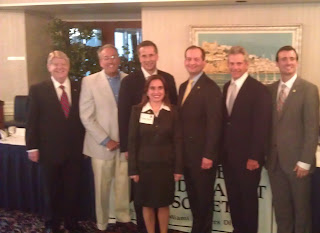
The night included everything one might expect a Federalist Society event to have: a well-stocked bar and plenty of time to mingle; a book co-authored by John Yoo, gifted to the panel members; a regional CIA recruiter mingling with the guests (no joke); Marshals to protect the dignitaries; and, the obligatory "Osama"...oops..."I sometimes say "Obama"" joke by a panelist.
All in all, it looked as if it was going to be a 'hanging jury' for Michael. As anybody who knows Michael would expect, Michael shined.
The discussion was very interesting and quite non-partisan. Essentially, it was a walk trough the history of the US Attorney's Office in the Southern District of Florida, from 9/11 onwards. Michael did a great job adding color to the other side of the equation - bringing home the impact that ramped up prosecutions for offenses such as routine immigration violations or the effects prolonged isolated confinement have on people.
Guy Lewis led off. He talked about how he and other members of the office sat watching the terrorist attacks unfold on 9/11 and the eerie "radio silence" that prevailed from DOJ during the attacks. 16 of the 19 hijackers had either lived in the Southern District or otherwise had connections here, and they were simply not on the radar. The day after 9/11 GL convened a meeting of federal and local law enforcement and began to redirect the priority of the office from prosecution of offenses such as violent crime, cyber crime and money laundering to the prosecution and prevention of terrorism.
Marcos Jimenez took over after GL left to D.C., and one of his first impressions was how much the office changed from when he had been a AUSA. MJ really gave the audience a good feel for how much pressure a US Attorney feels while in the office, including the fear that his efforts would not be enough to prevent an attack from happening. MJ specifically mentioned port security and the nightmare scenario that something would happen on a cruse ship, and bunch of people would get killed and he would have "egg on his face."
Other than Michael (who I admit to being partisan to and who will always have my vote), Dean Alex Acosta was the most impressive speaker of the night. I did not realize what an intellectual the guy is. AA gave a terrific overview of military tribunals in the United States, going back to Nazi spies in the beginning of WWII. Whether you agree or disagree with the policies the government pursued post-9/11, it is very apparent that AA had thoroughly thought through the legal basis for the actions taken, and would be able to provide justification for each and every one. Frankly, if AA presents like this always, I fully expect to be calling him Judge in the future - if that is what he is after.
Jeff Sloman, who had been involved in terrorism prosecutions and investigations before 9/11, spoke to a concern that was raised by MJ. Radicalized people who are willing to die for a cause. Such concerns led to cases such as the Liberty City 7 case, that were targeted at neutralizing threats before they became capable of carrying out a terrorist act.
Willy Ferrer was obviously more constrained in what he could say because he is the current US Attorney - he was able to provide statistics and a broad overview of efforts that are ongoing to prevent terrorist acts. But what WF said that struck me most, was the mention of his law school class mate - Geoffrey Cloud, who went to work in the World Trade Center on 9/11 and was killed in the attacks.
I am certain that people like WF, who lost friends during 9/11 will not forget the destruction of that day. Whether you agree or disagree with the policies that our government pursues, folks like those who hold the office of US Attorney in the Southern District of Florida are tasked with keeping us all safe. I want them to remember that day, and I want that memory to drive them to do the best job they can.
Whether ultra left or ultra right, we all hate terrorism and want our government to keep us safe. That is the point that Michael was really able to drive home - yes, we need to be kept safe, but at the same time, we need to protect our Constitutional liberties and hold true to the values that have made us this great Nation.
How far can law enforcement can go to protect us? God forbid something terrible happens again - law enforcement did not go far enough. In the name of terrorism prevention, continue prosecuting immigrants who try to sneak into America with the sole intention of working hard and earning a living - too far.
It is a very difficult question to address, and the reason that we should all encourage participation in more events like the Federalist Society panel discussion. That organization and its leadership deserve a lot of credit for gathering the panelists together to attempt to confront the issues.
The threat is real, it is deadly, and we do not want the people protecting us to forget it.
 - Bette and Peter Cloud, the parents of terrorist attack victim Geoffrey Cloud of Sudbury, speak about their son to people gathered for a 9/11 remembrance at the September 11th Memorial Garden at Heritage Park in Sudbury Sunday.
Last night the Federalist Society hosted an event at the Banker's Club entitled "War Zone or Crime Scene: Walking the Tightrope of Justice Ten Years After September 11th."
The panel included every person who held the position of US Attorney since 9/11 - Guy Lewis, Marcos Jimenez, Alex Acosta, Jeff Sloman, Wilfredo Ferrer, and acting Federal Public Defender Michael Caruso, who proved a bit elusive to the camera. Neal Sonnet moderated.

The night included everything one might expect a Federalist Society event to have: a well-stocked bar and plenty of time to mingle; a book co-authored by John Yoo, gifted to the panel members; a regional CIA recruiter mingling with the guests (no joke); Marshals to protect the dignitaries; and, the obligatory "Osama"...oops..."I sometimes say "Obama"" joke by a panelist.
All in all, it looked as if it was going to be a 'hanging jury' for Michael. As anybody who knows Michael would expect, Michael shined.
The discussion was very interesting and quite non-partisan. Essentially, it was a walk trough the history of the US Attorney's Office in the Southern District of Florida, from 9/11 onwards. Michael did a great job adding color to the other side of the equation - bringing home the impact that ramped up prosecutions for offenses such as routine immigration violations or the effects prolonged isolated confinement have on people.
Guy Lewis led off. He talked about how he and other members of the office sat watching the terrorist attacks unfold on 9/11 and the eerie "radio silence" that prevailed from DOJ during the attacks. 16 of the 19 hijackers had either lived in the Southern District or otherwise had connections here, and they were simply not on the radar. The day after 9/11 GL convened a meeting of federal and local law enforcement and began to redirect the priority of the office from prosecution of offenses such as violent crime, cyber crime and money laundering to the prosecution and prevention of terrorism.
Marcos Jimenez took over after GL left to D.C., and one of his first impressions was how much the office changed from when he had been a AUSA. MJ really gave the audience a good feel for how much pressure a US Attorney feels while in the office, including the fear that his efforts would not be enough to prevent an attack from happening. MJ specifically mentioned port security and the nightmare scenario that something would happen on a cruse ship, and bunch of people would get killed and he would have "egg on his face."
Other than Michael (who I admit to being partisan to and who will always have my vote), Dean Alex Acosta was the most impressive speaker of the night. I did not realize what an intellectual the guy is. AA gave a terrific overview of military tribunals in the United States, going back to Nazi spies in the beginning of WWII. Whether you agree or disagree with the policies the government pursued post-9/11, it is very apparent that AA had thoroughly thought through the legal basis for the actions taken, and would be able to provide justification for each and every one. Frankly, if AA presents like this always, I fully expect to be calling him Judge in the future - if that is what he is after.
Jeff Sloman, who had been involved in terrorism prosecutions and investigations before 9/11, spoke to a concern that was raised by MJ. Radicalized people who are willing to die for a cause. Such concerns led to cases such as the Liberty City 7 case, that were targeted at neutralizing threats before they became capable of carrying out a terrorist act.
Willy Ferrer was obviously more constrained in what he could say because he is the current US Attorney - he was able to provide statistics and a broad overview of efforts that are ongoing to prevent terrorist acts. But what WF said that struck me most, was the mention of his law school class mate - Geoffrey Cloud, who went to work in the World Trade Center on 9/11 and was killed in the attacks.
I am certain that people like WF, who lost friends during 9/11 will not forget the destruction of that day. Whether you agree or disagree with the policies that our government pursues, folks like those who hold the office of US Attorney in the Southern District of Florida are tasked with keeping us all safe. I want them to remember that day, and I want that memory to drive them to do the best job they can.
Whether ultra left or ultra right, we all hate terrorism and want our government to keep us safe. That is the point that Michael was really able to drive home - yes, we need to be kept safe, but at the same time, we need to protect our Constitutional liberties and hold true to the values that have made us this great Nation.
How far can law enforcement can go to protect us? God forbid something terrible happens again - law enforcement did not go far enough. In the name of terrorism prevention, continue prosecuting immigrants who try to sneak into America with the sole intention of working hard and earning a living - too far.
It is a very difficult question to address, and the reason that we should all encourage participation in more events like the Federalist Society panel discussion. That organization and its leadership deserve a lot of credit for gathering the panelists together to attempt to confront the issues.
The threat is real, it is deadly, and we do not want the people protecting us to forget it.
 - Bette and Peter Cloud, the parents of terrorist attack victim Geoffrey Cloud of Sudbury, speak about their son to people gathered for a 9/11 remembrance at the September 11th Memorial Garden at Heritage Park in Sudbury Sunday.
Tuesday, September 13, 2011
Kindergarten cop
District Judge Sam Sparks recently got the attention of blogs and email lists with his "Kindergarten Order."
Edith Jones, the Chief Judge of the 5th Circuit, wasn't happy with the order and sent Judge Sparks this email:
Ouch. According to the Texas Lawyer, Jones wasn't happy her email got out:
What do you all think of Sparks' initial order and Jones' email? I guess all of this could segue into the discussion of the new Florida Bar rule on civility, but I'm tired after watching the Dolphins last night so I can't think of a witty way to do it.
Edith Jones, the Chief Judge of the 5th Circuit, wasn't happy with the order and sent Judge Sparks this email:
Dear Sam, It has not escaped my attention, or that of my colleagues or, I am told, nationally known blog sites that you have issued several ‘cute’ orders in the past few weeks. The order attached below is the most recent. Frankly, this kind of rhetoric is not funny. In fact, it is so caustic, demeaning, and gratuitous that it casts more disrespect on the judiciary than on the now-besmirched reputation of the counsel. It suggests either that the judge is simply indulging himself at the expense of counsel or that he is fighting with counsel in what, as Judge Gee used to say, is surely not a fair contest. It suggests bias against counsel. No doubt, none of us has been consistently above reproach in our professional communications with counsel. We are all prone to human error. But no judge who writes an order should allow such rhetoric to overcome common sense. Ultimately, this kind of excess, as I noted, reflects badly on all of us. I urge you to think before you write. Sincerely, Edith Jones.
Ouch. According to the Texas Lawyer, Jones wasn't happy her email got out:
Jones declines comment on the substance of the e-mail but says she was “saddened” that it had been released to others, including Texas Lawyer. “It’s an internal matter,” Jones says. “And I’m saddened that somebody breached the intended limited scope of the intended distribution.”
What do you all think of Sparks' initial order and Jones' email? I guess all of this could segue into the discussion of the new Florida Bar rule on civility, but I'm tired after watching the Dolphins last night so I can't think of a witty way to do it.
Monday, September 12, 2011
Federal Courthouse in WPB evacuated this morning (UPDATED -- Courthouse reopened)
From the PBP:
UPDATE -- OK, back to work. The courthouse has been reopened. Here's the coverage:
A federal courthouse in Florida has been evacuated while authorities investigate a suspicious vehicle parked nearby.
West Palm Beach police spokesman Chase Scott says a police dog alerted to the possibility of explosives inside the rental van after 8 a.m. Monday. It was being checked because of unspecified derogatory comments written on the outside of the van.
A post office and a state health department building were also evacuated.
A police bomb squad and Homeland Security Department officials were among those responding to the situation.
Authorities have been on heightened alert nationwide for potential terrorist activity coinciding with the 10th anniversary of the Sept. 11 attacks.
UPDATE -- OK, back to work. The courthouse has been reopened. Here's the coverage:
West Palm Beach Police have determined that a "suspicious van" parked across from the federal courthouse downtown is not a threat and begun the process of clearing the scene, according to police spokesman Chase Scott.
He said hundreds of workers are being let back into the federal courthouse, Florida Health Department, U.S. Post Office and other surrounding buildings.
It's still unclear why a police bomb-sniffing dog alerted on the rental box-style moving van this morning, Scott said. It could have been some previous cargo in the unattended vehicle, which had been parked "for at least a day."
But the van's side panel attracted attention with the block-lettered message: "Google Edgar Bushey. Frank Baker PBSO lied and did no investigation" - a message that Scott characterized as "anti-law enforcement."
"Given the date, the location, the fact that it was a rental vehicle, has (anti-law enforcement) graffiti all over it," Scott added, "We were taking an abundance of precautions."
The van is being impounded and is now the subject of a West Palm Beach police investigation, he said. It is unclear who owns the van. A Google search of the name, "Edgar Bushey," takes one to a website and seemingly official documents regarding a 1995 sexual assault investigation.
Is Big Brother spelled GPS?
That's the question Adam Liptak asks in his weekend NY Times piece on the upcoming Supreme Court case:
There's also some interesting stuff in the DBR today, like Brian's op-ed (which I can't comment on since I'm still litigating the case), and Pacenti's article about the local jails.
In a series of rulings on the use of satellites and cellphones to track criminal suspects, judges around the country have been citing George Orwell’s “1984” to sound an alarm. They say the Fourth Amendment’s promise of protection from government invasion of privacy is in danger of being replaced by the futuristic surveillance state Orwell described.
In April, Judge Diane P. Wood of the federal appeals court in Chicago wrote that surveillance using global positioning system devices would “make the system that George Orwell depicted in his famous novel, ‘1984,’ seem clumsy.” In a similar case last year, Chief Judge Alex Kozinski of the federal appeals court in San Francisco wrote that “1984 may have come a bit later than predicted, but it’s here at last.”
Last month, Judge Nicholas G. Garaufis of the Federal District Court in Brooklyn turned down a government request for 113 days of location data from cellphone towers, citing “Orwellian intrusion” and saying the courts must “begin to address whether revolutionary changes in technology require changes to existing Fourth Amendment doctrine.”
The Supreme Court is about to do just that. In November, it will hear arguments in United States v. Jones, No. 10-1259, the most important Fourth Amendment case in a decade. The justices will address a question that has divided the lower courts: Do the police need a warrant to attach a GPS device to a suspect’s car and track its movements for weeks at a time?
Their answer will bring Fourth Amendment law into the digital age, addressing how its 18th-century prohibition of “unreasonable searches and seizures” applies to a world in which people’s movements are continuously recorded by devices in their cars, pockets and purses, by toll plazas and by transit systems.
The Jones case will address not only whether the placement of a space-age tracking device on the outside of a vehicle without a warrant qualifies as a search, but also whether the intensive monitoring it allows is different in kind from conventional surveillance by police officers who stake out suspects and tail their cars.
There's also some interesting stuff in the DBR today, like Brian's op-ed (which I can't comment on since I'm still litigating the case), and Pacenti's article about the local jails.
Wednesday, September 07, 2011
News and Notes
1. Lots of people (91 in total and 45 in Miami!) charged with Medicare Fraud today.
2. Psychics get bond. But they knew that already.
3. Check out this footnote at the end of the opinion in United States v. Smith, which held that an appellate waiver was enforceable: After this opinion was written, the government filed a motion to withdraw its previously filed brief, which had argued that the appeal waiver applies, to vacate the sentence, and to remand for resentencing under the decision in United States v. Rojas, 645 F.3d 1234 (11th Cir. 2011). The motion admits that the sentencing appeal waiver does apply but states that the government has now “determined that it is appropriate under the circumstances to forego reliance upon the appeal waiver provision in this case.” OK, now what?
UPDATE -- I missed the continuation of the footnote on the next page:
The primary circumstance cited in the government’s motion is that Attorney General Eric Holder has changed the Department of Justice’s policy on whether the Fair Sentencing Act applies to cases in which the defendant was sentenced after enactment of that legislation. There has not, however, been any change in the law concerning sentence appeal waivers, and it is on the basis of the waiver that we are deciding this case. Sentence appeal waivers serve interests of the judiciary as well as interests of the government and defendants. See United States v. Bascomb, 451 F.3d 1292, 1296–97 (11th Cir. 2006) (interests of the government and defendants); cf. Blackledge v. Allison, 431 U.S. 63, 71, 97 S.Ct. 1621, 1627 (1977) (recognizing
that plea bargains benefit all concerned, including the judiciary). And once an appeal arrives in this Court it is our responsibility to see that it is decided correctly under the law. For these reasons, the government’s motion is denied.
Wow.
2. Psychics get bond. But they knew that already.
3. Check out this footnote at the end of the opinion in United States v. Smith, which held that an appellate waiver was enforceable: After this opinion was written, the government filed a motion to withdraw its previously filed brief, which had argued that the appeal waiver applies, to vacate the sentence, and to remand for resentencing under the decision in United States v. Rojas, 645 F.3d 1234 (11th Cir. 2011). The motion admits that the sentencing appeal waiver does apply but states that the government has now “determined that it is appropriate under the circumstances to forego reliance upon the appeal waiver provision in this case.” OK, now what?
UPDATE -- I missed the continuation of the footnote on the next page:
The primary circumstance cited in the government’s motion is that Attorney General Eric Holder has changed the Department of Justice’s policy on whether the Fair Sentencing Act applies to cases in which the defendant was sentenced after enactment of that legislation. There has not, however, been any change in the law concerning sentence appeal waivers, and it is on the basis of the waiver that we are deciding this case. Sentence appeal waivers serve interests of the judiciary as well as interests of the government and defendants. See United States v. Bascomb, 451 F.3d 1292, 1296–97 (11th Cir. 2006) (interests of the government and defendants); cf. Blackledge v. Allison, 431 U.S. 63, 71, 97 S.Ct. 1621, 1627 (1977) (recognizing
that plea bargains benefit all concerned, including the judiciary). And once an appeal arrives in this Court it is our responsibility to see that it is decided correctly under the law. For these reasons, the government’s motion is denied.
Wow.
Wesley Snipes loses bid for new trial in the 11th Circuit

Here's the unpublished opinion affirming the denial of his motion for new trial.
From the AP:
From the AP:
The 11th U.S. Circuit Court of Appeals rejected the appeal by Snipes, who was convicted in 2008 on three misdemeanor counts of willful failure to file income tax returns.
His defense lawyers contended they received emails from former jurors reporting misconduct among other members of the panel. One of the former jurors said in the email that three other jurors acknowledged they had determined Snipes was guilty before the trial began.
A federal court rejected the request for a new trial and noted that there were reasons to question the veracity of the allegations made in the emails. The 11th Circuit upheld the ruling on Tuesday, finding that there wasn't "strong, substantial and incontrovertible evidence" that would warrant a new trial.
Tuesday, September 06, 2011
Miami Herald profiles Judge Jordan
Jay Weaver does a nice job here. From the article:
And the Palm Beach Post rightfully calls for Obama to get this done quickly:
As an undergraduate at UM, Jordan was a walk-on with the Hurricanes baseball team. He would joke to friends that he played “left bench.”Relatives, friends and peers always described “Bert” Jordan as “scary smart,” a whiz kid.
He excelled as a political science major before finishing second in his UM law-school class. He earned a spot on the Law Review. One of his articles was on the use in legal filings of sports metaphors, entitled “Imagery, Humor and Judicial Opinion,’’ which “simply celebrates the prankster and poet in all of us.”
In 1987, Jordan applied to all nine U.S. Supreme Court justices for a clerkship. O’Connor granted him an interview. She picked him and three others from a field of 10.
But before he went to Washington, Jordan spent a year working for 11th Circuit Judge Thomas Clark in Atlanta.
Back then, he told The Miami Herald that he was following an “unwritten rule” that says clerking for a federal judge is a prerequisite for a Supreme Court clerkship. Quipped Jordan: It applies to “anyone who’s not at Harvard or Yale.”
And the Palm Beach Post rightfully calls for Obama to get this done quickly:
There is no need for such delay over Judge Jordan, an American success story. He came to the U.S. from Cuba as a 6-year-old with his parents. After receiving his bachelor's and law degrees with honors from the University of Miami, he clerked for former Supreme Court Justice Sandra Day O'Connor, worked in private practice and served as a federal prosecutor before becoming a judge at only 38.
Normally, when senators from both states agree on a judicial nominee, he or she is confirmed without controversy. Sen. Marco Rubio, a Republican, would be the one to raise any opposition. According to his press aide, though, Sen. Rubio "has heard nothing but positive things about Judge Jordan, and he looks forward to presenting his nomination before the Judiciary Committee for its consideration." The Senate confirmed Judge Jordan 93-1 in 1999. The result now should be about the same.
Friday, September 02, 2011
Friday notes
Sorry for the slow blogging this week. A couple quick hits before the nice long weekend:
1. No kindergarten party for lawyers after all. (WSJ)
2. What's going to happen with Clemens? We'll find out soon. (Boston.com)
3. Pleading and buyer's remorse (NYT)
4. Fascinating comments by jurors in the MS-13 gang case (Law.com)
5. DC Circuit divided on 3 evidence cases (BLT)
That's all I got today. Hope you have a nice weekend.
Thursday, September 01, 2011
Tuesday, August 30, 2011
New magistrate short list in WPB
The cut has been made and there are 10 finalists for two spots. It's very hush-hush though, and I only have a partial list. Come on tipsters, give me more. Here's what I have so far:
Carolyn Bell (AUSA)
Dave Brannon (AFPD)
Kim Dunn-Abel (AUSA)
Bill Matthewman
Jeremy Slusher
Bob Waters (AUSA)
Wendy Zoberman
There are a bunch of magistrate positions that are open in the District, so the Chief entered an intersting order precluding applicants from lobbying District Judges. Good move.
Carolyn Bell (AUSA)
Dave Brannon (AFPD)
Kim Dunn-Abel (AUSA)
Bill Matthewman
Jeremy Slusher
Bob Waters (AUSA)
Wendy Zoberman
There are a bunch of magistrate positions that are open in the District, so the Chief entered an intersting order precluding applicants from lobbying District Judges. Good move.
Fantasy Football anyone?
Having won last year, I'm retiring. But Miguel de la O needs a title and the league needs one more team before tomorrow night. First come, first serve. Here's the info for joining
League ID#: 552661
League Name: SDFLA Fantasy Football
Password: markusquit
Custom League URL: http://football.fantasysports.yahoo.com/league/sdfla
Draft Type: Live Standard Draft
Draft Time: Wed Aug 31 10:30pm EDT
League ID#: 552661
League Name: SDFLA Fantasy Football
Password: markusquit
Custom League URL: http://football.fantasysports.yahoo.com/league/sdfla
Draft Type: Live Standard Draft
Draft Time: Wed Aug 31 10:30pm EDT
Monday, August 29, 2011
Judge Jordan's application
Judge Jordan's nomination is, by all accounts, moving quickly towards confirmation. Here is his Senate questionnaire (which is unbelievably onerous and long):
Judge Jordan's CA11 Questionnaire
If you aren't interested in that sort of thing, here is the trailer for the new Hunger Games movie coming out in the spring. Go Katniss!
Judge Jordan's CA11 Questionnaire
If you aren't interested in that sort of thing, here is the trailer for the new Hunger Games movie coming out in the spring. Go Katniss!
Friday, August 26, 2011
Have a nice weekend
Nothing really going on today in Miami, so I apologize for the slow blogging...
Anyway, here are some pictures I snapped on the way to lunch today in downtown:


Anyway, here are some pictures I snapped on the way to lunch today in downtown:


Thursday, August 25, 2011

11th Circuit considers Liberty City Seven
Jay Weaver has the details about this interesting issue:
The judge’s removal of a woman from the federal jury in one of the nation’s most controversial terrorism trials dominated oral arguments Tuesday, in the appeal of five Miami men convicted of conspiring to aid al-Qaida.
The unidentified woman, known only as Juror No. 4, was dismissed by U.S. District Judge Joan Lenard after deliberating for nearly three days in late April 2009 because the other 11 jurors said she refused to discuss the fate of the remaining defendants in a group originally dubbed the “Liberty City Seven.’’
The ruling led to the juror’s replacement by an alternate juror, a man, and the eventual conviction of the five defendants on material-support conspiracy charges. One other defendant was acquitted.
The removal of Juror No. 4 from the 12-person panel carried great consequences.
Had she been allowed to hold out as the minority juror, prompting a third mistrial in the controversial case, the five defendants could have walked out of the courtroom free, because the U.S. attorney’s office had already said it wouldn’t try them a fourth time.
Defense lawyers said Tuesday that Lenard made a major error about Juror No. 4 that should compel the 11th U.S. Circuit Court of Appeals to throw out the convictions and order a new trial. A decision could take months.
Juror No. 4 “goes in there and makes up her mind,” said attorney Ana Jhones, who represented the ringleader in the Liberty City group. “Does that mean she’s not deliberating? There is evidence that Juror No. 4 was, in fact, deliberating.”
She also said the woman was intimidated by the foreman in the jury room.
But a prosecutor with the U.S. attorney’s office disagreed.
Assistant U.S. Attorney Jonathan Colan said Juror No. 4 indicated to a courtroom deputy even before the start of deliberations that she didn’t want to discuss the evidence. She just wanted to express her opinion.
“Every other juror [questioned by the judge] gave consistent testimony that she turned her back and wouldn’t follow the law,” Colan said.
The convictions of the five men followed two earlier mistrials, which had resulted in the acquittal of one other defendant.
Tuesday, August 23, 2011

Monday, August 22, 2011
Slow blogging today
Your friendly neighborhood blogger is in court today, so I won't have much on the web until much later. Until then, your moment of zen:
| The Daily Show With Jon Stewart | Mon - Thurs 11p / 10c | |||
| Moment of Zen - Anderson Cooper Cracks Up | ||||
| ||||
Friday, August 19, 2011
Defense Verdicts of the Week
The USAO is very good at issuing press releases when there is an arrest or a conviction. Not so much when there is an acquittal. And there were some acquittals and a hung jury this week:
1. Sabrina Puglisi and Margot Moss got a not guilty before Judge Jordan in a drug case in which their client testified.*
2. AFPDs Aimee Ferrer and Jan Smith won before Judge Seitz in a gun case.
3. AFPD Miguel Caridad and David Joffe hung a jury before Judge Cooke. Apparently, Joffe's client originally pled guilty but was permitted to withdraw the plea and now is going for round 2.
*Full disclosure -- I share space with Sabrina and Margot is my law partner.
1. Sabrina Puglisi and Margot Moss got a not guilty before Judge Jordan in a drug case in which their client testified.*
2. AFPDs Aimee Ferrer and Jan Smith won before Judge Seitz in a gun case.
3. AFPD Miguel Caridad and David Joffe hung a jury before Judge Cooke. Apparently, Joffe's client originally pled guilty but was permitted to withdraw the plea and now is going for round 2.
*Full disclosure -- I share space with Sabrina and Margot is my law partner.
Judge makes mistake and goes after criminal defense lawyer
This story really amazes me:
This investigation reminds me of the old F. Lee Bailey quote after he was charged with mail fraud: In England, a criminal defense lawyer is apt to be knighted, in America, he is apt to be indicted.
This is especially true where the criminal defense lawyer is representing an unpopular defendant like Casey. The Florida Bar should quickly clear Jose Baez.
At issue: Anthony pleaded guilty to 13 charges in a check fraud case in January 2010. Judge Stan Strickland sentenced her to time-served in jail, and a year of probation after her jail release.
But last month, when Anthony was acquitted of murder and released from the Orange County Jail, she wasn't put on probation. The Department of Corrections said Anthony served that probation in jail while she was awaiting the murder trial.
Soon after her release, Strickland amended his original order clarifying his intentions, which were clear in video and transcripts from the January 2010 sentencing.
Anthony's defense team objected, and Perry heard arguments from attorneys earlier this month.
Perry asked the defense team if they knew Anthony was serving her probation while she was in jail. One of Anthony's attorneys admitted that they did, but didn't think it was their burden to notify the court.
Perry eventually issued an order stating Anthony does have to report to probation.
In that order, Perry took up the issue with the attorneys too, saying that, "the failure to abide by that order and the failure to notify the court of a known scrivener's error in the order may be a violation of an attorney's duty of candor."
"No attorney should conduct himself or herself in a way that impedes an order of the court. ... Our system of justice should never be in the position of rewarding someone who willfully hides the ball."
This investigation reminds me of the old F. Lee Bailey quote after he was charged with mail fraud: In England, a criminal defense lawyer is apt to be knighted, in America, he is apt to be indicted.
This is especially true where the criminal defense lawyer is representing an unpopular defendant like Casey. The Florida Bar should quickly clear Jose Baez.
Wednesday, August 17, 2011
Judge Milton Hirsch finds Florida drug law unconstitutional
Milt Hirsch wrote a compelling (and very entertaining) order finding Florida's drug statute unconstitutional, following the decision in Shelton. The whole order is worth a read. Here is the intro and conclusion, and a link to the whole order at the bottom:
"[F]or there is nothing either good or bad, but thinking makes it so."
--William Shakespeare, The Tragedy of Hamlet, Prince of Denmark, Act II sc. 2
I. Introduction
The 39 defendants captioned above are similarly circumstanced in that all are charged with violation of Fla. Stat. § 893.13. In light of the recent decision in Shelton v. Department of Corrections, No. 6:07-cv-839-Orl-35-KRS, 2011 WL 3236040 (M.D. Fla. July 27, 2011), finding '893.13 unconstitutional, all defendants move for dismissal. I have consolidated these cases for purposes of these motions only.
Shelton has produced a category-five hurricane in the Florida criminal practice community. A storm-surge of pretrial motions (such as those at bar) must surely follow. It is, therefore, essential that I adjudicate the present motions promptly. This order has been written in great haste and under great time pressure. As Mark Twain is alleged to have said: "If I'd had more time, I could have written you a shorter letter."
***
V. Conclusion
The immediate effect of the present order is the dismissal of charges against all movants – the overwhelming majority of whom may have known perfectly well that their acts of possession or delivery were contrary to law. Viewed in that light, these movants are unworthy, utterly unworthy, of this windfall exoneration. But as no less a constitutional scholar than Justice Felix Frankfurter observed, "It is easy to make light of insistence on scrupulous regard for the safeguards of civil liberties when invoked on behalf of the unworthy. It is too easy. History bears testimony that by such disregard are the rights of liberty extinguished, heedlessly at first, then stealthily, and brazenly in the end." Davis v. United States, 328 U.S. 582, 597 (1946) (Frankfurter, J., dissenting).
Like the court in Shelton, I find that Florida Statute § 893.13 is facially violative of the Due Process Clause of the 14th Amendment to the United States Constitution; and, accordingly, that any prosecution brought pursuant to that statute is subject to dismissal.
In the comments the other day, there was a discussion about whether Shelton was binding. Judge Hirsch has a lot to say about that, including this conclusion:
In the absence of such particularization I am obliged as a Florida trial court to presume that Florida appellate courts relied upon a Florida-law-based guarantee of due process, whether constitutional or common-law. No Florida case has decided the issue presently before me: whether '893.13 is unconstitutional by operation of the 14th Amendment to the federal Constitution. The Shelton court reached the same conclusion: A[N]o Florida appellate [court] ... has addressed the constitutionality of ['893.13] under the federal Constitution,@ Shelton, 2011 WL 3236040, at *12; and the Florida cases that appear to give passing consideration to the issue of the constitutionality or not of the statute Acontain no analysis of or citation to the tripartite constitutional analysis@ required by Staples and other U.S. Supreme Court authorities, and employed in Shelton. Id. See also supra note 3. Accordingly, I am bound to follow Shelton=s holding that '893.13 violates the 14th Amendment=s due process guarantee.
Hirsch Order
"[F]or there is nothing either good or bad, but thinking makes it so."
--William Shakespeare, The Tragedy of Hamlet, Prince of Denmark, Act II sc. 2
I. Introduction
The 39 defendants captioned above are similarly circumstanced in that all are charged with violation of Fla. Stat. § 893.13. In light of the recent decision in Shelton v. Department of Corrections, No. 6:07-cv-839-Orl-35-KRS, 2011 WL 3236040 (M.D. Fla. July 27, 2011), finding '893.13 unconstitutional, all defendants move for dismissal. I have consolidated these cases for purposes of these motions only.
Shelton has produced a category-five hurricane in the Florida criminal practice community. A storm-surge of pretrial motions (such as those at bar) must surely follow. It is, therefore, essential that I adjudicate the present motions promptly. This order has been written in great haste and under great time pressure. As Mark Twain is alleged to have said: "If I'd had more time, I could have written you a shorter letter."
***
V. Conclusion
The immediate effect of the present order is the dismissal of charges against all movants – the overwhelming majority of whom may have known perfectly well that their acts of possession or delivery were contrary to law. Viewed in that light, these movants are unworthy, utterly unworthy, of this windfall exoneration. But as no less a constitutional scholar than Justice Felix Frankfurter observed, "It is easy to make light of insistence on scrupulous regard for the safeguards of civil liberties when invoked on behalf of the unworthy. It is too easy. History bears testimony that by such disregard are the rights of liberty extinguished, heedlessly at first, then stealthily, and brazenly in the end." Davis v. United States, 328 U.S. 582, 597 (1946) (Frankfurter, J., dissenting).
Like the court in Shelton, I find that Florida Statute § 893.13 is facially violative of the Due Process Clause of the 14th Amendment to the United States Constitution; and, accordingly, that any prosecution brought pursuant to that statute is subject to dismissal.
In the comments the other day, there was a discussion about whether Shelton was binding. Judge Hirsch has a lot to say about that, including this conclusion:
In the absence of such particularization I am obliged as a Florida trial court to presume that Florida appellate courts relied upon a Florida-law-based guarantee of due process, whether constitutional or common-law. No Florida case has decided the issue presently before me: whether '893.13 is unconstitutional by operation of the 14th Amendment to the federal Constitution. The Shelton court reached the same conclusion: A[N]o Florida appellate [court] ... has addressed the constitutionality of ['893.13] under the federal Constitution,@ Shelton, 2011 WL 3236040, at *12; and the Florida cases that appear to give passing consideration to the issue of the constitutionality or not of the statute Acontain no analysis of or citation to the tripartite constitutional analysis@ required by Staples and other U.S. Supreme Court authorities, and employed in Shelton. Id. See also supra note 3. Accordingly, I am bound to follow Shelton=s holding that '893.13 violates the 14th Amendment=s due process guarantee.
Hirsch Order
Tuesday, August 16, 2011
11th Circuit discusses THUG MANSION
Per Judge Carnes:
This appeal stems from a violent drug conspiracy in South Florida that involved a number of criminals, most of whom have aliases or nicknames. The four whose joint trial led to this appeal were Daniel “D.V.” Varela, Liana “The Negra” Lopez, Ricardo “Rick” Sanchez, and Daniel “Homer” Troya. Showing a keen appreciation for their own character, they referred to the townhouse where they lived as the “Thug Mansion.” During their crime wave two of the self-styled thugs, Troya and Sanchez, carjacked a fellow drug dealer and shot him to death. What would have been unfortunate became triply tragic when they also gunned down the drug dealer’s wife and their two children, ages three and four. Troya and Sanchez left all four bodies on the side of the road.
The ensuing police investigation led to the Thug Mansion, which was located in a gated residential community. Officers executed a search warrant there and found evidence of the murder and the on-going drug conspiracy. An indictment and two superseding indictments followed, and then a trial at which the four defendants were convicted on all counts. Lopez and Varela, who brought this appeal, raise several issues, the primary one being that they should not have been jointly tried with Troya and Sanchez, who committed the murders. (Sanchez and Troya were convicted of those murders and sentenced to death, and they have filed appeals that are proceeding separately from this one.)
Who wants to guess how this one came out?
Here's Tupac discussing "Thugz Mansion" (NSFW):
This appeal stems from a violent drug conspiracy in South Florida that involved a number of criminals, most of whom have aliases or nicknames. The four whose joint trial led to this appeal were Daniel “D.V.” Varela, Liana “The Negra” Lopez, Ricardo “Rick” Sanchez, and Daniel “Homer” Troya. Showing a keen appreciation for their own character, they referred to the townhouse where they lived as the “Thug Mansion.” During their crime wave two of the self-styled thugs, Troya and Sanchez, carjacked a fellow drug dealer and shot him to death. What would have been unfortunate became triply tragic when they also gunned down the drug dealer’s wife and their two children, ages three and four. Troya and Sanchez left all four bodies on the side of the road.
The ensuing police investigation led to the Thug Mansion, which was located in a gated residential community. Officers executed a search warrant there and found evidence of the murder and the on-going drug conspiracy. An indictment and two superseding indictments followed, and then a trial at which the four defendants were convicted on all counts. Lopez and Varela, who brought this appeal, raise several issues, the primary one being that they should not have been jointly tried with Troya and Sanchez, who committed the murders. (Sanchez and Troya were convicted of those murders and sentenced to death, and they have filed appeals that are proceeding separately from this one.)
Who wants to guess how this one came out?
Here's Tupac discussing "Thugz Mansion" (NSFW):
Monday, August 15, 2011


Back to work
Thanks to Rick for his excellent blogging, as usual.
A few items to start the week:
1. Enjoy the last week before school starts on the 22nd. Then back to parking-lot traffic. Ugh. (btw, shouldn't school start after Labor Day?)
2. In case you didn't see it, the Eleventh Circuit held 2-1 that President Obama's healthcare legislation was unconstitutional. Judges Dubina and Hull wrote a "joint opinion" and Judge Marcus dissented. Let's see what the Supremes do.
3. Florida state judges are saying (via Miami Herald) that they aren't bound by a federal judge's decision that the Florida drug statute is unconstitutional. I'm hearing that the same thing is occurring with Judge Martinez's order on the Florida death penalty -- state judges are saying that they aren't bound by the decision. But aren't they under the Supremacy Clause? Isn't this what federal habaes is all about? If state judges can just respond -- well, that's nice, but we'll decide what our state law says -- then why have habeas at all?
Thursday, August 04, 2011
Summer speaking
Lots of Supreme Court Justices speaking this summer in really nice places. The latest are Justices Roberts and Kagan.
Justice Roberts has a rule about not speaking while on vacation, but he broke it and spoke in Maine:
"When judges or justices speak in court, there's a good chance we will disappoint half of the people who appear before us. When we speak in public, we have a good chance of disappointing everyone," Roberts said. "Despite that clear and present danger, I was happy to accept your kind invitation to visit this afternoon."
***
Roberts said that while he appreciates the efficiency of the information age, he worries that modern methods of legal research could make it easier to confuse the collection of information with the acquisition of knowledge.
"I hope that the generations that follow will get a chance to experience learning in the enriching environment of a real library and not just a virtual one – a library where you feel connected to knowledge in a very tangible way and also connected to those working alongside you in a similar pursuit for knowledge," he said, "even if they're representing an adversary or even if they're working for a judge who will decide your case."
And Justice Kagan spoke in Aspen:
“I think this comes as a surprise to many people when I talk about my experiences on the court, and to me as well,” Kagan said during a conversation in the Greenwald Pavilion at the Aspen Institute. “You know you read the court's decisions, and often there's some pretty sharp give-and-take: people accusing other justices on the other side [of the issue] of a wide variety of terrible conduct.”
“The truth is, it is an incredibly collegial and warm institution, with good friendships throughout the court and across whatever people think of as ideological divides, and that was the nicest feature of joining the court, was feeling that,” she said. “And how well and respectfully the members of the institution operate together.”
Justice Roberts has a rule about not speaking while on vacation, but he broke it and spoke in Maine:
"When judges or justices speak in court, there's a good chance we will disappoint half of the people who appear before us. When we speak in public, we have a good chance of disappointing everyone," Roberts said. "Despite that clear and present danger, I was happy to accept your kind invitation to visit this afternoon."
***
Roberts said that while he appreciates the efficiency of the information age, he worries that modern methods of legal research could make it easier to confuse the collection of information with the acquisition of knowledge.
"I hope that the generations that follow will get a chance to experience learning in the enriching environment of a real library and not just a virtual one – a library where you feel connected to knowledge in a very tangible way and also connected to those working alongside you in a similar pursuit for knowledge," he said, "even if they're representing an adversary or even if they're working for a judge who will decide your case."
And Justice Kagan spoke in Aspen:
“I think this comes as a surprise to many people when I talk about my experiences on the court, and to me as well,” Kagan said during a conversation in the Greenwald Pavilion at the Aspen Institute. “You know you read the court's decisions, and often there's some pretty sharp give-and-take: people accusing other justices on the other side [of the issue] of a wide variety of terrible conduct.”
“The truth is, it is an incredibly collegial and warm institution, with good friendships throughout the court and across whatever people think of as ideological divides, and that was the nicest feature of joining the court, was feeling that,” she said. “And how well and respectfully the members of the institution operate together.”
Tuesday, August 02, 2011
BREAKING -- Kathy Williams confirmed! Yes!

Wow, lots of great news today in the District. First, as discussed below, Judge Adalberto Jordan was nominated to fill Judge Susan Black's seat on the 11th Circuit. So we're losing one great judge, but we gain another -- the Senate just unanimously confirmed Kathy Williams to sit on the Southern District of Florida (Judge Hurley's seat).
I'm so happy for Kathy. It took wayyy too long, but that's a story that's been written about quite a bit and today is not the day to rehash it. Today is the the day to celebrate for Kathy. And yes, I'm biased -- I used to work for her at the Federal Public Defender's office, where she is known and respected around the country as running the model FPD office.
She's going to be a fantastic judge -- smart, hardworking, and compassionate. What else do you want from a federal judge?
The picture is Kathy from her confirmation hearings.
Congrats to Judge Adalberto Jordan!
 President Obama nominated him today to sit on the 11th Circuit. He will be terrific on the court of appeals but will be sorely missed on the district court where he was known for his smarts, his patience, for treating everyone with respect and for calling 'em right down the middle.
Here's the press release from the White House:
President Obama Nominates Judge Adalberto José Jordán to the United States Court of Appeals
WASHINGTON, DC – Today, President Obama nominated Judge Adalberto José Jordán to the United States Court of Appeals for the Eleventh Circuit.
“Judge Adalberto José Jordán will bring an unwavering commitment to fairness and judicial integrity to the federal bench,” President Obama said. “His impressive legal career is a testament to the kind of thoughtful and diligent judge he will be on the Eleventh Circuit. I am honored to nominate him today.”
Judge Adalberto José Jordán: Nominee for the United States Court of Appeals for the Eleventh Circuit
Judge Adalberto José Jordán has served as a District Judge on the United States District Court for the Southern District of Florida in Miami since 1999. He also teaches as an adjunct professor of law at University of Miami School of Law, where he has taught since 1990, and Florida International University College of Law, where he has taught since 2007. Judge Jordán was born in Havana, Cuba, and immigrated to the United States with his parents at the age of six. He received his B.A. magna cum laude from the University of Miami in 1984, and his J.D. summa cum laude from University of Miami School of Law in 1987. After graduating from law school, he served as a law clerk to the Honorable Thomas A. Clark of the United States Court of Appeals for the Eleventh Circuit from 1987 to 1988, and the following year he served as a law clerk to the Honorable Sandra Day O’Connor of the Supreme Court of the United States. In 1989, Judge Jordán joined the Miami law firm of Steel Hector & Davis LLP (now Squire Sanders & Dempsey) as a litigation associate, eventually specializing in appellate practice and becoming a partner in 1994. Later that year, he joined the United States Attorney’s Office in the Southern District of Florida, serving as an Assistant United States Attorney in the appellate division and handling criminal and civil appeals on behalf of the government. Judge Jordán became appellate division chief in the office in 1998, and also served as special counsel to the United States Attorney for legal policy. Since being appointed to the District Court bench in 1999, Judge Jordán has presided over nearly 200 trials on a wide range of civil and criminal matters. In addition, he has frequently sat by designation on the United States Court of Appeals for the Eleventh Circuit.
August in Miami
It's boiling outside and there's a hurricane that may slide by us this weekend, but at least there's no traffic.
Now that the debt deal is about done, the Senate has the rest of the week before the August recess to get Kathy Williams and Bob Scola confirmed. Let's see what happens.
Big reversal in the Second Circuit yesterday in US v. Ferguson. The AP summarizes the case this way:
Oh, and Rumpole is finally back from his vacation.
Now that the debt deal is about done, the Senate has the rest of the week before the August recess to get Kathy Williams and Bob Scola confirmed. Let's see what happens.
Big reversal in the Second Circuit yesterday in US v. Ferguson. The AP summarizes the case this way:
Former executives of American International Group Inc. and General Re Corp. who were convicted in a $500 million fraud case deserve a new trial, because the judge at their 2008 trial wrongly admitted stock-price data into evidence and gave improper jury instructions, a federal appeals court ruled Monday.
The 2nd U.S. Circuit Court of Appeals threw out the fraud convictions for the five officials and sent the case back to U.S. District Court in Hartford.
Prosecutors had accused the executives of participating in a scheme in which New York-based AIG secretly paid Stamford-based Gen Re to take out reinsurance policies with AIG in 2000 and 2001 to boost AIG's falling stock price. Reinsurance policies are backups purchased by insurance companies to completely or partly insure risk they have assumed for their customers.
Ronald E. Ferguson, Elizabeth A. Monrad, Robert D. Graham and Christopher P. Garand, all former executive officers of Gen Re, and Christian M. Milton, AIG's vice president of reinsurance, were sentenced to prison in 2009 for their involvement in the scheme, which authorities estimate cost AIG shareholders more than $500 million.
Testimony from two cooperating witnesses associated with Gen Re helped convict the five executives of conspiracy, mail fraud, securities fraud and false statements to the Securities and Exchange Commission. They received sentences ranging from one to four years in jail, but remain free on bail pending the outcome of the appeal.
***
[Chief Judge Jacobs] said the verdicts had to be vacated because of how U.S. District Judge Christopher Droney handled stock-price evidence and because Droney gave jury instruction that influenced the verdict.
The lower court was inconsistent in its rulings on displaying stock-price charts, Jacobs said. One chart showing the full decline in stock price was excluded as overly prejudicial, but it was "functionally identical" to another chart shown during prosecutors' opening statement, he said.
"The court's solution, to allow only isolated ranges of stock-price data, did not mitigate the prejudice," Jacobs wrote. "Instead of a downward line, there were three dropping sets of dots; it is inevitable that jurors would connect them."
In instructing the jury, the trial judge erred by offering an ambiguous standard of conviction that allowed the jury to convict without determining what caused the fraud, Jacobs wrote.
Oh, and Rumpole is finally back from his vacation.
Monday, August 01, 2011
Justice Ginsburg is funny!
Here's a recent speech she gave to the Otsego County Bar Association, which I found to be a great read (One example: “I am now delighted to report that not once this term has an advocate called me Justice Sotomayor or Justice Kagan, and the same holds true for my junior colleagues.")
JoshBlackman.com summarized some of the questions Justice Ginsburg reviewed from this Term (Ginsburg: “From the foregoing samples, you may better understand why the court does not plan to permit televising oral arguments any time soon.”):
• “What [did] James Madison th[ink] about video games?” --Justice Samuel A. Alito Jr. in Brown v. Entertainment Merchants Association.
• “What do you think about Satan?” -- Justice Antonin Scalia in Matrixx Initiatives v. Siracusano.
• “Does al-Qaida know all this stuff?” --Justice Antonin Scalia in NASA v. Nelson. (after a lawyer for the employees said they worked in a “campus atmosphere” and they posed little or no security risk).
• “Where is the 9,000-foot cow?” --Justice Stephen G. Breyer in AT&T Mobility v. Concepcion, involving Breyer’s hypothetical involving a Swiss law only allowing the purchase of milk from cattle grazing in pastures higher than 9,000 feet.
JoshBlackman.com summarized some of the questions Justice Ginsburg reviewed from this Term (Ginsburg: “From the foregoing samples, you may better understand why the court does not plan to permit televising oral arguments any time soon.”):
• “What [did] James Madison th[ink] about video games?” --Justice Samuel A. Alito Jr. in Brown v. Entertainment Merchants Association.
• “What do you think about Satan?” -- Justice Antonin Scalia in Matrixx Initiatives v. Siracusano.
• “Does al-Qaida know all this stuff?” --Justice Antonin Scalia in NASA v. Nelson. (after a lawyer for the employees said they worked in a “campus atmosphere” and they posed little or no security risk).
• “Where is the 9,000-foot cow?” --Justice Stephen G. Breyer in AT&T Mobility v. Concepcion, involving Breyer’s hypothetical involving a Swiss law only allowing the purchase of milk from cattle grazing in pastures higher than 9,000 feet.
Friday, July 29, 2011
Bob Barr and I agree!
Here's an op-ed he just wrote on the over-criminalization problem in America. From the piece:
[F]ailure to address the overcriminalization of America is turning us into a society in which the average citizen is at the mercy of the federal government for fear of running afoul of some criminal law or regulation on any given day, despite having no intention whatsover of doing so.
The explosive growth in the number of federal crimes in recent decades has been nothing short of phenomenal. Three crimes — three — were considered of sufficient importance and of a unique federal nature, to be included specifically in the Constitution. Those three uniquely federal crimes are treason, piracy and counterfeiting. Over the decades, of course, other crimes were added, usually pegged to the infamous “commerce clause.” By 1980, the federal criminal code had mushroomed to about 3,000 separate criminal offenses. What has happened since 1980, however, has been nothing short of phenomenal — the list of federal criminal offenses has exploded to nearly 4,500 offenses; as noted most recently by Gary Fields and John Emshwiller in the Wall Street Journal. This figure does not even include the many more thousands of federal regulations that can be enforced by the government as criminal offenses.
***
The list of such unfair and outrageous instances of abusive federal prosecutions is depressingly long; with many the result of the explosive growth of “environmental crimes” since the birth of the EPA four decades ago. Yet Congress after Congress continues to add crime after crime to the burgeoning federal criminal code, based often on pressure from interest groups and federal agencies themselves.
[F]ailure to address the overcriminalization of America is turning us into a society in which the average citizen is at the mercy of the federal government for fear of running afoul of some criminal law or regulation on any given day, despite having no intention whatsover of doing so.
The explosive growth in the number of federal crimes in recent decades has been nothing short of phenomenal. Three crimes — three — were considered of sufficient importance and of a unique federal nature, to be included specifically in the Constitution. Those three uniquely federal crimes are treason, piracy and counterfeiting. Over the decades, of course, other crimes were added, usually pegged to the infamous “commerce clause.” By 1980, the federal criminal code had mushroomed to about 3,000 separate criminal offenses. What has happened since 1980, however, has been nothing short of phenomenal — the list of federal criminal offenses has exploded to nearly 4,500 offenses; as noted most recently by Gary Fields and John Emshwiller in the Wall Street Journal. This figure does not even include the many more thousands of federal regulations that can be enforced by the government as criminal offenses.
***
The list of such unfair and outrageous instances of abusive federal prosecutions is depressingly long; with many the result of the explosive growth of “environmental crimes” since the birth of the EPA four decades ago. Yet Congress after Congress continues to add crime after crime to the burgeoning federal criminal code, based often on pressure from interest groups and federal agencies themselves.
Thursday, July 28, 2011
Finalists for U.S. Marshal
They are: James S. Higgins, Eben Morales and Amos Rojas Jr..
Many of you will remember Jaime Higgins, who is an ATF agent, currently on assignment in Vancouver, Canada. His wife is Celeste Higgins, a former AFPD in Miami.
Many of you will remember Jaime Higgins, who is an ATF agent, currently on assignment in Vancouver, Canada. His wife is Celeste Higgins, a former AFPD in Miami.
Wednesday, July 27, 2011
Florida drug laws ruled unconstitutional
Today Judge Mary Scriven from the Middle District granted a writ of habeas corpus and declared Florida’s drug law unconstitutional. The case is Shelton v. Dept. of Corrections. NACDL filed this amicus brief . Here's the intro to the order:
On May 13, 2002, the Florida Legislature enacted changes to Florida’s Drug Abuse Prevention and Control law, FLA. STAT. § 893.13, as amended by FLA. STAT. § 893.101. By this enactment, Florida became the only state in the nation expressly to eliminate mens rea as an element of a drug offense. This case, challenging the constitutionality of that law, was filed following Plaintiff’s conviction for delivery of cocaine without the jury being required to consider his intent in any respect and the subsequent imposition of an eighteen year sentence following his conviction. Upon consideration of all relevant filings, case law, and being otherwise fully advised, the Court GRANTS Petitioner’s request for habeas relief (Dkt. 1), and finds that FLA. STAT. § 893.13 is unconstitutional on its face.
Full disclosure: I was one of the co-signors of the amicus brief for NACDL, authored by Todd Foster.
On May 13, 2002, the Florida Legislature enacted changes to Florida’s Drug Abuse Prevention and Control law, FLA. STAT. § 893.13, as amended by FLA. STAT. § 893.101. By this enactment, Florida became the only state in the nation expressly to eliminate mens rea as an element of a drug offense. This case, challenging the constitutionality of that law, was filed following Plaintiff’s conviction for delivery of cocaine without the jury being required to consider his intent in any respect and the subsequent imposition of an eighteen year sentence following his conviction. Upon consideration of all relevant filings, case law, and being otherwise fully advised, the Court GRANTS Petitioner’s request for habeas relief (Dkt. 1), and finds that FLA. STAT. § 893.13 is unconstitutional on its face.
Full disclosure: I was one of the co-signors of the amicus brief for NACDL, authored by Todd Foster.
Tuesday, July 26, 2011
BREAKING -- JNC sends 4 names to Senators
Your next federal judge will be one of these four people:
Jerald Bagley
John O'Sullivan
Robin Rosenbaum
John Thornton
Two State Circuit judges and two Federal Magistrates. I'm picturing a cage match -- Bagley and Thornton vs. O'Sullivan and Rosenbaum. Who wins that one?
Update-- happy to report that Judge Moreno's letters were cited yesterday in the Senate. Hopefully they will have some impact. Here's the link: http://www.gpo.gov/fdsys/pkg/CREC-2011-07-25/pdf/CREC-2011-07-25-pt1-PgS4860.pdf#page=1
HT: SFL
Jerald Bagley
John O'Sullivan
Robin Rosenbaum
John Thornton
Two State Circuit judges and two Federal Magistrates. I'm picturing a cage match -- Bagley and Thornton vs. O'Sullivan and Rosenbaum. Who wins that one?
Update-- happy to report that Judge Moreno's letters were cited yesterday in the Senate. Hopefully they will have some impact. Here's the link: http://www.gpo.gov/fdsys/pkg/CREC-2011-07-25/pdf/CREC-2011-07-25-pt1-PgS4860.pdf#page=1
HT: SFL
Monday, July 25, 2011
"Characterizing a government as a pimp is far from advocating violence."
That was Irfan Khan's lawyer Sowmya Bharathi, challenging the strength of the evidence against her client who is accused of helping to finance part of the Pakistani Taliban terror group. Love the quote! Plus it gave me some inspiration for the morning:
More on the case from Curt Anderson's article:
More on the case from Curt Anderson's article:
The son of a Muslim cleric in South Florida was a key part of his father's alleged finance network for the Pakistani Taliban terror group and shared the older man's support for violent attacks, an FBI agent testified Tuesday.
Agent Michael Ferlazzo said at a bail hearing that 37-year-old Irfan Khan appears to advocate violence repeatedly on some of the more than 1,000 phone calls the FBI recorded between him and his father, brother and other alleged conspirators.
On one call, Ferlazzo said, Irfan Khan referred to Pakistan's government as “big pimps.”
“They're talking about violent opposition to the government,” Ferlazzo said. On another call, the agent said, Irfan Khan seemed pleased that people feared the Pakistani Taliban “because of how lethal they had become.”
***
But Irfan Khan's attorney, Sowmaya Bharathi, said most of his comments could be chalked up to passionate political talk about Pakistan's government and its troubles, not evidence of support for terrorism.
“There is absolutely nothing wrong with people exchanging information about horrible events in a part of the world they have a connection to,” Bharathi said. “Characterizing a government as a pimp is far from advocating violence.”
She said nearly two dozen people, including members of Irfan Khan's cricket team, were willing to put up cash and property to secure his release on bail. She noted that he has a wife and two young children in Florida and would be able to get a job driving a taxi if released.
“He is going to stay here and fight the charges,” Bharathi said.
Jordan has not said when he will rule on bail for Izhar Khan, who is imam at a mosque in suburban Margate. Hafiz Khan is imam at Miami's oldest mosque.
Thursday, July 21, 2011
Chief Judge starts letter writing campaign for Kathy Williams and Bob Scola
Congrats to Bob Scola, who received a unanimous voice vote today getting out of the judiciary committee.
Now, Chief Judge Moreno has written letters to Senator Mitch McConnell and Senator Harry Reid urging confirmation by the full Senate of Kathy Williams and Bob Scola before the August recess. The intro from the letters:
Now it's our turn. Please follow Judge Moreno's lead and send letters now to get Williams and Scola confirmed.
Now, Chief Judge Moreno has written letters to Senator Mitch McConnell and Senator Harry Reid urging confirmation by the full Senate of Kathy Williams and Bob Scola before the August recess. The intro from the letters:
As Chief Judge of the United States District Court for the Southern District of Florida, I urge you to expedite the Senate's confirmation of Kathleen Williams and Robert Scola to the positions of district judges in our district. I understand that the Judiciary Committee has sent both nominations by unanimous voice vote and is awaiting a vote by the full Senate. Ms. Williams, our district's Federal Public Defender, has been awaiting confirmation for the longest period of any present nominee to the district court in the entire country. State Judge Robert Scola's nomination is of a more recent vintage but the litigants are eagerly awaiting his confirmation.
The judgeship Ms. Williams has been nominated to fill has been vacant for two years! At the present time, our district has three vacancies. Unfilled positions in our Court present an undue hardship on the citizens residing in the Southern District of Florida, particularly those with cases pending in the affected division of the Court. Our district is huge and heavily populated. It includes the most populous counties in Florida, Miami-Dade, Broward (where Fort Lauderdale is located) and Palm Beach Counties. The district also includes Monroe, St. Lucie, Highlands, Okeechobee, Martin, and Indian River Counties.
Now it's our turn. Please follow Judge Moreno's lead and send letters now to get Williams and Scola confirmed.
Wednesday, July 20, 2011
Why is Lanny A. Breuer attacking the defense bar?
Assistant Attorney General Lanny A. Breuer of the Criminal Division spoke at the National District Attorneys Association Summer Conference in Sun Valley, Idaho today and said the following:
How strange, no?
Was this a message to the judge in the Roger Clemens case that he should find that the prosecutors simply made an honest mistake? If you were Roger Clemens, wouldn't you want your lawyer to pursue the issue and fight for no retrial? To bar a retrial, part of what the defense must show is that the behavior of the prosecutors was intentional. Clemens' lawyer would be committing malpractice not to argue that it was intentional after the prosecutors disregarded the judge's order by playing the tape and then leaving the image on the screen during the sidebar. Don't prosecutors argue that defendants have acted in bad faith all of time based on far less circumstantial evidence?
In any event, I challenge Mr. Breuer to a debate on the subject of prosecutorial and defense ethics. Just for starters, I would ask Mr. Breuer why DOJ is opposing a change to Rule 16 (as suggested by the ABA and on July 7, by NACDL) requiring what their guidelines merely suggest.
I have written an op-ed on this subject, as have others.
I do like the part where he says prosecutors must seek justice, not a win. Here's part of what I wrote about that (back in May) in connection with the government's discovery obligations:
Before I conclude my remarks this morning, and I hope there will be plenty of time left for questions, I want to discuss one other issue with you, on which we are all focused: our ethical obligations as prosecutors.
As I and others have detailed elsewhere, the Justice Department has taken a series of far-reaching steps in the past two years to ensure that all federal prosecutors consistently meet their disclosure obligations. These measures – such as providing guidance to federal prosecutors on gathering and reviewing discoverable information and making timely disclosure to defendants, or instituting a requirement that all federal prosecutors take annual discovery training – are important steps forward. And I think it’s fair to say that, as a Department, we are in a better place today than we were two-and-a-half years ago. And I suspect that is true for many DA’s offices across the country as well.
Certain defense lawyers nevertheless continue to want to try and turn honest mistakes into instances of misconduct. This kind of gamesmanship is unfortunate. The steps we have taken go further than what the Supreme Court requires. And they go well beyond what any prior Administration has done. That’s a fact. Do we need to remain vigilant? Absolutely. At the same time, together, we cannot – and I know we will not – shy away from taking hard cases, or otherwise shrink from our obligation to investigate and prosecute criminal activity without fear or favor, because of the possibility that an opportunistic defense lawyer will try and make hay out of an honest mistake.
As prosecutors, we occupy a unique role in the criminal justice system. Our job is not just to win cases, but also to do justice in every case. I think prosecutors are more aware of their ethical obligations today than they may ever have been – and, as far as I’m concerned, that’s a good thing.
How strange, no?
Was this a message to the judge in the Roger Clemens case that he should find that the prosecutors simply made an honest mistake? If you were Roger Clemens, wouldn't you want your lawyer to pursue the issue and fight for no retrial? To bar a retrial, part of what the defense must show is that the behavior of the prosecutors was intentional. Clemens' lawyer would be committing malpractice not to argue that it was intentional after the prosecutors disregarded the judge's order by playing the tape and then leaving the image on the screen during the sidebar. Don't prosecutors argue that defendants have acted in bad faith all of time based on far less circumstantial evidence?
In any event, I challenge Mr. Breuer to a debate on the subject of prosecutorial and defense ethics. Just for starters, I would ask Mr. Breuer why DOJ is opposing a change to Rule 16 (as suggested by the ABA and on July 7, by NACDL) requiring what their guidelines merely suggest.
I have written an op-ed on this subject, as have others.
I do like the part where he says prosecutors must seek justice, not a win. Here's part of what I wrote about that (back in May) in connection with the government's discovery obligations:
The AG reminded prosecutors that they were tasked with doing justice, not winning. Ethical standards established by most state bar rules also require disclosure, even if the evidence is not “material.”
All of this sounded very promising, but actions speak louder than words.
Prosecutors continue to keep their files closed, telling lawyers and judges that they need not disclose basic items such as interview reports of witnesses, even when those witnesses lie under oath, because their boss’s guidelines and state ethical rules are not the law and therefore are not binding on them.
Because of these recurring problems, on April 22, 2011, in Miami, the American Bar Association’s Criminal Justice Section passed a resolution “urging” a change in the federal rules to require prosecutors to timely disclose all favorable information to the defense.
Only the Department of Justice member of the section voted against the resolution, arguing that individual prosecutors could be trusted without such a rule. Many judges, including Paul Friedman in Washington, D.C., have explained why the “trust us” argument is flawed: “Most prosecutors are neither neutral (nor should they be) nor prescient, and any such judgment necessarily is speculative on … many matters that simply are unknown and unknowable before trial begins.”
Based on these guidelines and cases, a simple — and what should have been uncontroversial — change was suggested to the federal criminal rules: prosecutors would be required to turn over all favorable information to the defense, not just “material” evidence.
Despite the ABA’s resolution, the Department of Justice just convinced the Criminal Rules Advisory Committee (the group that recommends changes to the Federal Rules of Criminal Procedure) to vote down (on a 6-5 vote) this proposed rule change.
Perhaps the Department of Justice would like to amend the plaque found in federal courtrooms that reads: “We who labor here seek the truth” with the addition, “only if we think it is material.”
Tuesday, July 19, 2011
This just makes my blood boil
I guess it shouldn't anymore because I really believe that Brady/Giglio violations happen in just about every trial where there isn't open-file discovery. The latest is a pretty shocking violation in the Casey Anthony case, which (I believe) would have resulted in a new trial had she been convicted. From the NY Times:
Assertions by the prosecution that Casey Anthony conducted extensive computer searches on the word “chloroform” were based on inaccurate data, a software designer who testified at the trial said Monday.
The designer, John Bradley, said Ms. Anthony had visited what the prosecution said was a crucial Web site only once, not 84 times, as prosecutors had asserted. He came to that conclusion after redesigning his software, and immediately alerted prosecutors and the police about the mistake, he said.
The finding of 84 visits was used repeatedly during the trial to suggest that Ms. Anthony had planned to murder her 2-year-old daughter, Caylee, who was found dead in 2008. Ms. Anthony, who could have faced the death penalty, was acquitted of the killing on July 5.
According to Mr. Bradley, chief software developer of CacheBack, used by the police to verify the computer searches, the term “chloroform” was searched once through Google. The Google search then led to a Web site, sci-spot.com, that was visited only once, Mr. Bradley added. The Web site offered information on the use of chloroform in the 1800s.
***
“I gave the police everything they needed to present a new report,” Mr. Bradley said. “I did the work myself and copied out the entire database in a spreadsheet to make sure there was no issue of accessibility to the data.”
Mr. Bradley, chief executive of Siquest, a Canadian company, said he even volunteered to fly to Orlando at his own expense to show them the findings.
Cheney Mason, one of Ms. Anthony’s defense lawyers, said it was “outrageous” that prosecutors withheld critical information on the “chloroform” searches.
“The prosecution is absolutely obligated to bring forth to the court any and all evidence that could be exculpatory,” Mr. Mason said. “If in fact this is true, and the prosecution concealed this new information, it is more than shame on them. It is outrageous.”
“This was a major part of their case,” Mr. Mason added.
In big trial after big trial there continues to be Brady violations. Imagine what happens on a daily basis in state and federal court where there isn't a great deal of scrutiny over what prosecutors do. There really needs to be open-file discovery and more needs to be done when prosecutors do not comply with their constitutional obligations.
Assertions by the prosecution that Casey Anthony conducted extensive computer searches on the word “chloroform” were based on inaccurate data, a software designer who testified at the trial said Monday.
The designer, John Bradley, said Ms. Anthony had visited what the prosecution said was a crucial Web site only once, not 84 times, as prosecutors had asserted. He came to that conclusion after redesigning his software, and immediately alerted prosecutors and the police about the mistake, he said.
The finding of 84 visits was used repeatedly during the trial to suggest that Ms. Anthony had planned to murder her 2-year-old daughter, Caylee, who was found dead in 2008. Ms. Anthony, who could have faced the death penalty, was acquitted of the killing on July 5.
According to Mr. Bradley, chief software developer of CacheBack, used by the police to verify the computer searches, the term “chloroform” was searched once through Google. The Google search then led to a Web site, sci-spot.com, that was visited only once, Mr. Bradley added. The Web site offered information on the use of chloroform in the 1800s.
***
“I gave the police everything they needed to present a new report,” Mr. Bradley said. “I did the work myself and copied out the entire database in a spreadsheet to make sure there was no issue of accessibility to the data.”
Mr. Bradley, chief executive of Siquest, a Canadian company, said he even volunteered to fly to Orlando at his own expense to show them the findings.
Cheney Mason, one of Ms. Anthony’s defense lawyers, said it was “outrageous” that prosecutors withheld critical information on the “chloroform” searches.
“The prosecution is absolutely obligated to bring forth to the court any and all evidence that could be exculpatory,” Mr. Mason said. “If in fact this is true, and the prosecution concealed this new information, it is more than shame on them. It is outrageous.”
“This was a major part of their case,” Mr. Mason added.
In big trial after big trial there continues to be Brady violations. Imagine what happens on a daily basis in state and federal court where there isn't a great deal of scrutiny over what prosecutors do. There really needs to be open-file discovery and more needs to be done when prosecutors do not comply with their constitutional obligations.
Monday, July 18, 2011
Federal Judge interviews in one week
Below is the schedule for next Monday. Any volunteers for a guest blogger to cover the interviews?
Jerald Bagley, 9am
William Thomas, 9:30
Beatrice Butchko, 10
Peter Lopez, 10:30
Robert Levenson, 11
Barry Seltzer, 11:30
John Thornton, Jr. 1pm
Caroline Heck Miller, 1:30
Robin Rosenbaum, 2
Marina Garcia Wood, 2:30
John J. O’Sullivan 3pm
Jerald Bagley, 9am
William Thomas, 9:30
Beatrice Butchko, 10
Peter Lopez, 10:30
Robert Levenson, 11
Barry Seltzer, 11:30
John Thornton, Jr. 1pm
Caroline Heck Miller, 1:30
Robin Rosenbaum, 2
Marina Garcia Wood, 2:30
John J. O’Sullivan 3pm
Too many lawyers, not enough judges
The NY Times has the story about the lawyers. The intro:
The basic rules of a market economy — even golden oldies, like a link between supply and demand — just don’t apply.
Legal diplomas have such allure that law schools have been able to jack up tuition four times faster than the soaring cost of college. And many law schools have added students to their incoming classes — a step that, for them, means almost pure profits — even during the worst recession in the legal profession’s history.
It is one of the academy’s open secrets: law schools toss off so much cash they are sometimes required to hand over as much as 30 percent of their revenue to universities, to subsidize less profitable fields.
In short, law schools have the power to raise prices and expand in ways that would make any company drool. And when a business has that power, it is apparently difficult to resist.
And BLT has the story about Obama's judicial appointment team. What's wrong with the administration on this?
The article is part of a 42-page package on “Obama’s Judiciary at Midterm,” by political scientists Sheldon Goldman of the University of Massachusetts at Amherst, Elliot Slotnick of Ohio State University and Sara Schiavoni of John Carroll University. (Click here for the Web site of Judicature, which is subscription-only and published by the American Judicature Society.)
The political scientists write that the White House shut out them, too, as they tried to put together the package. Their work is the latest in a long-running series.
“Tellingly, no one from the White House Counsel’s Office was able or willing to meet with us — the first time in our over 30 years of conducting our research on judicial selection that we have not had cooperation from that office,” the researchers write.
They add: “While the perspective from the White House Counsel’s Office would have been welcome, we believe that our other sources have enabled us to provide an accurate portrait of the successes and failures of the president’s judicial selection team. Other sources included interest group participants from groups along the ideological continuum.”
But too many lawyers and lack of federal judges seems like the same ol' stories again and again, no?
To me, the more interesting story is the Clemens trial and what's going to happen now that there was a mistrial. Here's Maureen Dowd's piece from the weekend:
But the trial had barely begun when those lawyers made what Tom Boswell, the Washington Post sports sage, called “the most shocking, inexplicable error in modern baseball history.” An error, Boswell said, that would cause the sports world and the legal community to “oscillate between pity and ridicule, incredulity and laughter, for years.”
With a high, close pitch at the government team, the judge declared a mistrial. “I think that a first-year law student would know you can’t bolster the credibility of one witness with clearly inadmissible evidence,” he said angrily.
Before the testimony started, Walton had said that an affidavit from Laura Pettitte was inadmissible. She had stated that her husband, Andy, who was Clemens’s teammate, told her that his pal had confided that he used human growth hormone. It was hearsay.
But on day two, the prosecutors played some video of the Capitol Hill hearing in which a congressman talked to Clemens about how compelling Laura Pettitte’s affidavit was. They even left her testimony on the monitors in the jury box while they gathered at the judge’s bench. It was such a chuckleheaded move that no one was sure whether the prosecutors had forgotten the judge’s ruling or were trying to sneak the testimony through a back door. Either way, it was another great day for defense lawyers and their clients who have already been convicted in the public eye.
“Government counsel doesn’t do just what government counsel can get away with doing,” the judge said sternly. “I’m very troubled by this. A lot of government money has been used to reach this point.” He added, “I don’t see how I can unring the bell.”
The basic rules of a market economy — even golden oldies, like a link between supply and demand — just don’t apply.
Legal diplomas have such allure that law schools have been able to jack up tuition four times faster than the soaring cost of college. And many law schools have added students to their incoming classes — a step that, for them, means almost pure profits — even during the worst recession in the legal profession’s history.
It is one of the academy’s open secrets: law schools toss off so much cash they are sometimes required to hand over as much as 30 percent of their revenue to universities, to subsidize less profitable fields.
In short, law schools have the power to raise prices and expand in ways that would make any company drool. And when a business has that power, it is apparently difficult to resist.
And BLT has the story about Obama's judicial appointment team. What's wrong with the administration on this?
The article is part of a 42-page package on “Obama’s Judiciary at Midterm,” by political scientists Sheldon Goldman of the University of Massachusetts at Amherst, Elliot Slotnick of Ohio State University and Sara Schiavoni of John Carroll University. (Click here for the Web site of Judicature, which is subscription-only and published by the American Judicature Society.)
The political scientists write that the White House shut out them, too, as they tried to put together the package. Their work is the latest in a long-running series.
“Tellingly, no one from the White House Counsel’s Office was able or willing to meet with us — the first time in our over 30 years of conducting our research on judicial selection that we have not had cooperation from that office,” the researchers write.
They add: “While the perspective from the White House Counsel’s Office would have been welcome, we believe that our other sources have enabled us to provide an accurate portrait of the successes and failures of the president’s judicial selection team. Other sources included interest group participants from groups along the ideological continuum.”
But too many lawyers and lack of federal judges seems like the same ol' stories again and again, no?
To me, the more interesting story is the Clemens trial and what's going to happen now that there was a mistrial. Here's Maureen Dowd's piece from the weekend:
But the trial had barely begun when those lawyers made what Tom Boswell, the Washington Post sports sage, called “the most shocking, inexplicable error in modern baseball history.” An error, Boswell said, that would cause the sports world and the legal community to “oscillate between pity and ridicule, incredulity and laughter, for years.”
With a high, close pitch at the government team, the judge declared a mistrial. “I think that a first-year law student would know you can’t bolster the credibility of one witness with clearly inadmissible evidence,” he said angrily.
Before the testimony started, Walton had said that an affidavit from Laura Pettitte was inadmissible. She had stated that her husband, Andy, who was Clemens’s teammate, told her that his pal had confided that he used human growth hormone. It was hearsay.
But on day two, the prosecutors played some video of the Capitol Hill hearing in which a congressman talked to Clemens about how compelling Laura Pettitte’s affidavit was. They even left her testimony on the monitors in the jury box while they gathered at the judge’s bench. It was such a chuckleheaded move that no one was sure whether the prosecutors had forgotten the judge’s ruling or were trying to sneak the testimony through a back door. Either way, it was another great day for defense lawyers and their clients who have already been convicted in the public eye.
“Government counsel doesn’t do just what government counsel can get away with doing,” the judge said sternly. “I’m very troubled by this. A lot of government money has been used to reach this point.” He added, “I don’t see how I can unring the bell.”
Friday, July 15, 2011
Should we be going bench more often?
The stats certainly say yes -- there are more federal bench acquittals than jury acquittals on a percentage basis. But the conventional wisdom is to go jury...
In any event, yesterday, Judge Moore said not guilty as the finder of fact in a visa fraud case. AFPDs Vanessa Chen and Helaine Batoff decided to go bench before Judge Moore and after he denied the Rule 29, he said that as the finder of fact he found the defendant not guilty.
In any event, yesterday, Judge Moore said not guilty as the finder of fact in a visa fraud case. AFPDs Vanessa Chen and Helaine Batoff decided to go bench before Judge Moore and after he denied the Rule 29, he said that as the finder of fact he found the defendant not guilty.
Thursday, July 14, 2011
“Government counsel doesn’t do just what government counsel can get away with doing …I’m very troubled by this."
Ouch. That was Judge Reggie Walton declaring a mistrial in the Roger Clemens case:
Judge Reggie B. Walton declared a mistrial in the Roger Clemens perjury trial today.
"He's entitled to a fair trial," said Walton. "He now cannot get it."
Lead defense attorney Rusty Hardin had asked for a mistrial because the prosecution revealed a statement to the jury that violated a pre-trial order. The prosecution also violated pre-trial orders when Assistant U.S. attorney Steven Durham talked about the Yankees' drug use during his opening statement.
Walton scheduled a Sept. 2 hearing to determine whether to hold a new trial for the former baseball star who pitched for four teams, including the Red Sox, during his 24-year career. Walton told jurors he was sorry to have wasted their time and spent so much taxpayer money, only to call off the case.
"There are rules that we play by and those rules are designed to make sure both sides receive a fair trial," Walton told the jury, saying such ground rules are critically important when a person's liberty is at stake.
He said that because prosecutors broke his rules, "the ability with Mr. Clemens with this jury to get a fair trial with this jury would be very difficult if not impossible."
In angry comments directed toward the prosecution, Walton said, “Government counsel doesn’t do just what government counsel can get away with doing …I’m very troubled by this. A lot of government money has been used to reach this point. The government should have been more cautious. I don’t see how I can un-ring the bell.”
By that, Walton meant that he could not figure out how the jury’s exposure to statements by Laura Pettitte, wife of former Yankees pitcher Andy Pettitte, can be erased from their memory so it does not later influence decision-making. Laura Pettitte is someone designed to bolster the credibility of her husband, a former teammate of Clemens who was expected to be a key witness in the trial. Under dispute in the case is whether Clemens mentioned using human growth hormone to Andy Pettitte.
Judge Reggie B. Walton declared a mistrial in the Roger Clemens perjury trial today.
"He's entitled to a fair trial," said Walton. "He now cannot get it."
Lead defense attorney Rusty Hardin had asked for a mistrial because the prosecution revealed a statement to the jury that violated a pre-trial order. The prosecution also violated pre-trial orders when Assistant U.S. attorney Steven Durham talked about the Yankees' drug use during his opening statement.
Walton scheduled a Sept. 2 hearing to determine whether to hold a new trial for the former baseball star who pitched for four teams, including the Red Sox, during his 24-year career. Walton told jurors he was sorry to have wasted their time and spent so much taxpayer money, only to call off the case.
"There are rules that we play by and those rules are designed to make sure both sides receive a fair trial," Walton told the jury, saying such ground rules are critically important when a person's liberty is at stake.
He said that because prosecutors broke his rules, "the ability with Mr. Clemens with this jury to get a fair trial with this jury would be very difficult if not impossible."
In angry comments directed toward the prosecution, Walton said, “Government counsel doesn’t do just what government counsel can get away with doing …I’m very troubled by this. A lot of government money has been used to reach this point. The government should have been more cautious. I don’t see how I can un-ring the bell.”
By that, Walton meant that he could not figure out how the jury’s exposure to statements by Laura Pettitte, wife of former Yankees pitcher Andy Pettitte, can be erased from their memory so it does not later influence decision-making. Laura Pettitte is someone designed to bolster the credibility of her husband, a former teammate of Clemens who was expected to be a key witness in the trial. Under dispute in the case is whether Clemens mentioned using human growth hormone to Andy Pettitte.
Wednesday, July 13, 2011
Blog makes news
Pretty cool -- Alyson Palmer of the Daily Report in Georgia wrote a nice story about the Rojas opinion disappearing and reappearing on the 11th Circuit website and our coverage of it:
The case of the missing opinion has been solved.
Court watchers had been scratching their heads after a June 24 sentencing opinion by a panel of the 11th U.S. Circuit Court of Appeals vanished from the court's website. Lawyers interested in reading the decision had to go to other sources, such as the Federal Public Defender's Office in Miami or a Miami lawyer's blog.
On Wednesday, more than one week after the Miami blogger noted on June 28 the opinion's disappearance, the decision reappeared on the court's site with the original June 24 date. A few hours later, a revised opinion was issued, mandating the same pro-defendant result and bearing the explanation that the panel had modified the opinion to reflect recent case law developments in other circuits.
According to Clerk of Court John Ley, the original opinion was withdrawn at the request of the judge who wrote it. (The unanimous three-judge panel was composed of Judges Charles R. Wilson and Beverly B. Martin and Senior Judge R. Lanier Anderson, but the opinion was unsigned.) "It happens every now and then," said Ley, "but then they reissued it once they reviewed their citations."
***
Within days of the opinion's issuance, however, it disappeared from the court's website. Noting the federal public defender's office was fielding requests for copies of the opinion, a University of Miami law professor, Ricardo J. Bascuas, posted the ruling on the blog of Miami attorney David O. Markus.
Lawyers at the federal public defender office that's handling the matter couldn't be reached to discuss what they were thinking when their case appeared in limbo, and federal prosecutors in Miami declined to comment. But others were talking.
"When a decision like that just disappears and there's no explanation and no reason given, it just makes the court look weird—I don't know the right word for it," Bascuas said in an interview Wednesday shortly before the opinion resurfaced on the court's site.
An anonymous comment on Markus' blog mused that perhaps the court was concerned that the upcoming vote by the federal sentencing commission on whether to make changes to the crack sentencing guidelines retroactive, scheduled for June 30, could moot the case. But the commission's decision to extend its guidelines changes even to those who were sentenced years ago didn't, and couldn't, change the mandatory minimums at issue in Rojas' case; the guideline changes would help the many inmates whose crimes involved drug quantities that placed their sentences beyond (often far beyond) the statutory minimums.
The case of the missing opinion has been solved.
Court watchers had been scratching their heads after a June 24 sentencing opinion by a panel of the 11th U.S. Circuit Court of Appeals vanished from the court's website. Lawyers interested in reading the decision had to go to other sources, such as the Federal Public Defender's Office in Miami or a Miami lawyer's blog.
On Wednesday, more than one week after the Miami blogger noted on June 28 the opinion's disappearance, the decision reappeared on the court's site with the original June 24 date. A few hours later, a revised opinion was issued, mandating the same pro-defendant result and bearing the explanation that the panel had modified the opinion to reflect recent case law developments in other circuits.
According to Clerk of Court John Ley, the original opinion was withdrawn at the request of the judge who wrote it. (The unanimous three-judge panel was composed of Judges Charles R. Wilson and Beverly B. Martin and Senior Judge R. Lanier Anderson, but the opinion was unsigned.) "It happens every now and then," said Ley, "but then they reissued it once they reviewed their citations."
***
Within days of the opinion's issuance, however, it disappeared from the court's website. Noting the federal public defender's office was fielding requests for copies of the opinion, a University of Miami law professor, Ricardo J. Bascuas, posted the ruling on the blog of Miami attorney David O. Markus.
Lawyers at the federal public defender office that's handling the matter couldn't be reached to discuss what they were thinking when their case appeared in limbo, and federal prosecutors in Miami declined to comment. But others were talking.
"When a decision like that just disappears and there's no explanation and no reason given, it just makes the court look weird—I don't know the right word for it," Bascuas said in an interview Wednesday shortly before the opinion resurfaced on the court's site.
An anonymous comment on Markus' blog mused that perhaps the court was concerned that the upcoming vote by the federal sentencing commission on whether to make changes to the crack sentencing guidelines retroactive, scheduled for June 30, could moot the case. But the commission's decision to extend its guidelines changes even to those who were sentenced years ago didn't, and couldn't, change the mandatory minimums at issue in Rojas' case; the guideline changes would help the many inmates whose crimes involved drug quantities that placed their sentences beyond (often far beyond) the statutory minimums.
Tuesday, July 12, 2011
"If American goes to World War III, I'll be in the front line. This is a great country."
That was Navy officer Elisha Leo Dawkins today after accepting pretrial diversion before Judge Altonaga. Gotta love that quote. Can't imagine a jury would convict a guy like that, but it's almost impossible to turn down diversion. From the Miami Herald:
In a surprise, his court-appointed lawyer Clark Mervis notified Judge Cecilia Altonaga that they had accepted the offer late Monday. Details were still secret Tuesday but his attorney said it did not address the issue of Dawkins’ citizenship. Separately, the U.S. immigration agency has agreed not to detain him on a 1992 removal order.
Experts have said such pre-trial probation packages typically involve rehabilitation, pledges to stay out of trouble and to undertake community service.
Altonaga agreed to abort the trial and send him to the program, provided Dawkins pay $1,600 in jury fees -- $40 to each citizen in a pool of 40 jury candidates assembled Tuesday morning, plus parking and transportation fees.
The debt became part of his probationary agreement.
In court, prosecutor Michael O’Leary said the sailor had a change of heart after hearing the case laid out in trial preparation on Monday. Federal prosecutors had made the offer, said O’Leary, because “his military service did mitigate” any alleged crime.
Outside court, Dawkins declined on the lawyer’s advice to explain if he still believed he was a U.S. citizen.
He declared that “the next project here” is sorting out “that situation” -- but said his experience persuaded him of the need to pass The Dream Act. It lets the children of foreigners who serve in the U.S. military attain American citizenship.
The case of the man who says he grew up believing he was American, that’s why he enlisted, energized pockets of Miami and the military.
In a surprise, his court-appointed lawyer Clark Mervis notified Judge Cecilia Altonaga that they had accepted the offer late Monday. Details were still secret Tuesday but his attorney said it did not address the issue of Dawkins’ citizenship. Separately, the U.S. immigration agency has agreed not to detain him on a 1992 removal order.
Experts have said such pre-trial probation packages typically involve rehabilitation, pledges to stay out of trouble and to undertake community service.
Altonaga agreed to abort the trial and send him to the program, provided Dawkins pay $1,600 in jury fees -- $40 to each citizen in a pool of 40 jury candidates assembled Tuesday morning, plus parking and transportation fees.
The debt became part of his probationary agreement.
In court, prosecutor Michael O’Leary said the sailor had a change of heart after hearing the case laid out in trial preparation on Monday. Federal prosecutors had made the offer, said O’Leary, because “his military service did mitigate” any alleged crime.
Outside court, Dawkins declined on the lawyer’s advice to explain if he still believed he was a U.S. citizen.
He declared that “the next project here” is sorting out “that situation” -- but said his experience persuaded him of the need to pass The Dream Act. It lets the children of foreigners who serve in the U.S. military attain American citizenship.
The case of the man who says he grew up believing he was American, that’s why he enlisted, energized pockets of Miami and the military.
Subscribe to:
Posts (Atom)