Thursday, May 26, 2011

Finale week


American Idol, Dancing with the Stars, Oprah...

Oh, you came here for law stuff. Fine:

1. Judge Dubina's daughter doesn't like the health care law. Here is Martha Dubina Roby's Facebook page. She is a freshman congresswoman from Alabama. Oral argument is in Atlanta on June 8, and the panel is Judges Dubina, Marcus and Hull.


2. Goodwin Liu has given up his bid to be on the 9th Circuit. The Senate should be ashamed.

3. Alan Mendelsohn wants a short sentence.

4. The 11th Circuit debates what "he" means in a prosecutor's closing argument. From Judge Wilson's dissent:

Attempting to bolster the credibility of Mark Duke’s cooperating codefendant, the prosecutor argued the following to the jury:

[Duke’s co-defendant] told the truth, ladies and gentlemen,
and here is how we know it, there’s a witness that you
heard from but he didn’t come in here and talk to you from
this witness stand. After he shot, stabbed, and cut the throat
of Randy Duke, he took Randy Duke’s blood with him
throughout that house.

In doing so, the prosecutor impermissibly commented on Duke’s decision not to testify, in violation of his Fifth Amendment right against self-incrimination. The majority is willing to accept the State’s explanation that the “he” the prosecutor was referring to was not really Mark Duke but was Randy Duke’s “blood.” It is willing to accept that the “blood” is a male “witness” that the jury “heard from.” It is willing to accept that the prosecutor used “2 he” in one sentence to refer to blood and “he” in the next sentence to refer to Mark Duke, without ever indicating any possible change of subject. This makes no sense because it would mean that Randy Duke’s blood “shot, stabbed, and cut the throat of Randy Duke” and that Randy Duke’s blood took itself “throughout the house.” The majority accepts this story even though the State could not consistently or coherently articulate such an argument in the moments after the comment was made, and despite the fact that the prosecutor who spoke it did not dispute that he was referring to Duke. I respectfully part company with my colleagues in accepting this logic.

I do not see how the jury could have possibly interpreted this statement as anything but a comment on Mark Duke’s failure to testify. Accordingly, I dissent.



Wednesday, May 25, 2011

News & Notes

1. Jeff Weiner has a new book. Check out this very useful resource -- Federal Criminal Rules & Codes plus. It's got everything a federal criminal lawyers needs in one handy place.

2. John Edwards may get charged. Amazing to me that we are wasting our scarce prosecutorial resources going after Edwards for being a scumbag.

3. Jared Loughner is incompetent. The arrest photo made that pretty clear, no?

4. How Appealing has this info about the panel for Obamacare:

An anonymous source reports that the three-judge panel will consist of Chief Judge Joel F. Dubina and Circuit Judges Frank M. Hull and Stanley Marcus.
Judges Hull and Marcus were both appointed to the Eleventh Circuit by President Clinton. Chief Judge Dubina was appointed to the Eleventh Circuit by the first President Bush. And don't let the fact that all three judges have seemingly male first names fool you, because Judge Hull is female.

Tuesday, May 24, 2011

Judge Reinhardt quotes 12 Angry Men...

...in this case. HT: MC. Good stuff:

Scene One

Juror #8: I just want to talk.

Juror #7: Well, what’s there to talk about? Eleven
men in here think he’s guilty. No one had
to think twice about it except you.

Juror #10: I want to ask you something: do you
believe his story?

Juror #8: I don’t know whether I believe it or not
— maybe I don’t.

Juror #7: So how come you vote not guilty?

Juror #8: Well, there were eleven votes for guilty.
It’s not easy to raise my hand and send
a boy off to die without talking about it
first. . . . We’re talking about somebody’s
life here. We can’t decide in five
minutes. Supposin’ we’re wrong.

Scene Two

Juror #6: I said . . . this is a very important case
and we should be very convinced that if
the defendant is found guilty that it is
beyond a reasonable doubt. . . .

Foreman: We have spent some time now trying to
understand the reasonable basis for his
doubt, and I personally did not yet
understand it . . . . I would say that twothirds
of the jurors have tried to persuade
— have actively tried to persuade . . .
him that his current view is incorrect.
. . .

Juror #4: Well, I guess he believes from the evidence
that he’s seen that there hasn’t
been sufficient proof. . . .

Juror #5: I think the question may have been
raised: “Do you have a political agenda?”
I think [it] might have been in the
heat of the argument, because it does get
heated back and forth from a bunch of
different people. It may have been said.
. . .

Juror #9: Well, he said this is a serious thing, and
I don’t really feel that there is enough
cause for — or something to that effect.
. . . What he said was, “I wouldn’t want
to take anyone’s freedom away, unless,”
you know, “I was sure that certain things
took place.” . . . .

The first passage above is dialogue from the classic Academy Award-winning 1957 film, Twelve Angry Men, in which Henry Fonda plays a holdout juror who, over two tense hours, convinces his eleven peers that the defendant in a murder trial
should be acquitted. The second excerpt comes from the transcript of proceedings during the petitioner’s murder trial, in which each juror was examined and cross-examined, seriatim and mid-deliberation, after it was reported that one juror was
taking a different view from the others. In the end, the trial court dismissed that juror on the ground that he was “biased” against the prosecution. With an alternate juror in place, the jury returned a guilty verdict.

Twelve Angry Men made for great drama because it violated the sanctity of the jury’s secret deliberations by allowing the audience into the jury room. It was, of course, a work of fiction. We are presented here with a similar intrusion into heated deliberations involving a holdout juror, except that this one took place in open court, and it resulted in a woman being convicted and sentenced to life imprisonment after the holdout was dismissed. Under the precedent that existed when petitioner’s conviction became final (and exists today as well), the trial court’s actions violated the petitioner’s Sixth Amendment rights, as incorporated with respect to the states under the Fourteenth Amendment. We therefore conclude that petitioner is in custody in violation of the Constitution, reverse the judgment of the district court, and remand with instructions to grant the writ.

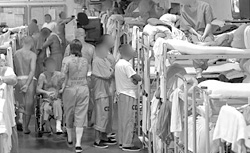
Justice Kennedy uses pictures in opinion...


... to show the overcrowding in California jails. There's one of them to the left. Yikes, that looks just awful.

Doug Berman asks whether visual aids are appropriate in opinions:

Because it has long been known that a picture is worth a thousand words, I certainly think it appropriate and useful for courts to consider adding visual aids to their rulings. And yet, I also recognize that a move to using more visual images in judicial opinions could open up a very interesting can of pictorial worms. In this Plata case and in some other settings, the visual aids added to opinion have usually been made part of the case's record by one of the parties. But I wonder if it would it be appropriate for an opinion to reprint a dramatic graphic or a special pictorial submitted into the record by the parties. Further still, might some justices or judges even consider creating their own special graphics or even a video to highlight and punctuate the pictures they are trying to create with their words?

Especially because I am a terrible artist, I hope graphic skills do not soon become essential to being an effective litigator. And yet, in this great new world full or new media, I do not think it is crazy to believe (and fear?) that visual images may begin playing a larger role in judicial decision-making.


I don't think there is anything to fear. Pictures and evidence from lower courts should be made part of opinions. It helps the reader and the public to see what is at issue. I like it.

Monday, May 23, 2011

Bail for 76-year old Imam? UPDATE -- nope

I was planning another rant (see here and here) this morning on the bail reform act and how DOJ's asks for detention way more than it should. But I have a small fire drill this morning on a case that I have to deal with...

John Pacenti and Jay Weaver have articles about the terrorism charges and the bond hearing this morning for Hafiz Muhammad Sher Ali Khan. Needless to say, I'm not sure why there couldn't be conditions of release set for Khan and his son that would ensure that he shows up for court and not engage in criminal activity. It's almost impossible to prepare for any trial, let alone a trial with classified material, while your client is detained (especially in the special housing unit).

I do like that I'll be able to say KHAN on the blog for the foreseeable future:


UPDATE -- Judge Garber denied bond for Khan and his son.