The DBR covers Judge Bandstra's departure to JAMS. Good luck to him! There are some good stories about him in the article:
Bandstra’s legal experience includes three years with Katten Muchin in
Chicago followed by three more as an assistant U.S. attorney trying 30
cases under Stanley Marcus. He also spent three years at Fowler White
Burnett handling medical malpractice for firm shareholder and co-founder
Henry Burnett.
“Henry’s my mentor and the person I respect most,” Bandstra said.
He said his experience as a magistrate can help sparring sides see their legal situation more realistically.
“One of the things I’ve enjoyed most as a judge is the settlement of cases where I’ve had some input,” Bandstra said.
After
South Florida’s district judges chose Bandstra as a magistrate in 1989,
U.S. District Judge Eugene Spellman telephoned to welcome him with two
interesting details.
“First of all, you weren’t my first choice,” Bandstra recalled him saying. “That took me back a little bit.
“The other thing was, ‘You should know you got the judges’ vote on the first ballot, which has never happened.’ ”
The debate last night was a good way to show how important facial expressions are during trial. In the first debate, Obama lost not so much for what he said, but mostly because he kept looking down, writing, and shaking his head.
Last night, Romney got trounced in part because he had this weird grin on his face all night which didn't seem appropriate.
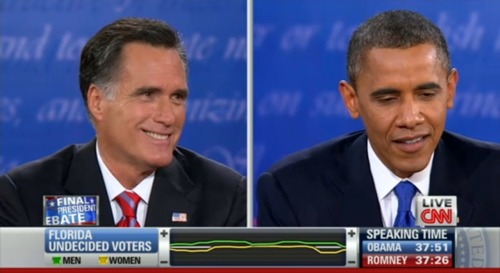
Plus, there was this:
The SDFLA Blog is dedicated to providing news and notes regarding federal practice in the Southern District of Florida. The New Times calls the blog "the definitive source on South Florida's federal court system." All tips on court happenings are welcome and will remain anonymous. Please email David Markus at dmarkus@markuslaw.com
Tuesday, October 23, 2012
Monday, October 22, 2012
Monday news & notes
1. Who wants to go to Pakistan? Apparently the defense does in what was dubbed the "Pakistani Taliban" case when it was filed lots of publicity but which seems much different now.
Jay Weaver covers the government's opposition here:
Two South Florida Muslim clerics — a father and son separated by more than 50 years in age — are struggling to persuade a Miami federal judge to allow their lawyers to travel to Pakistan to question alleged Taliban sympathizers who might help their defense against terrorism charges. Lawyers for Hafiz Khan and Izhar Khan, former imams of mosques in Miami and Margate, have already lost their first bid to travel with federal prosecutors to the U.S. Embassy in Islamabad to take depositions from five witnesses who do not want to come to Miami to testify at the upcoming trial. Among the potential witnesses are two other Khan family members and another suspected Taliban supporter who were accused in the same case of conspiring to aid the Taliban with money and guns.
Last week, U.S. District Judge Robert Scola rejected the defense’s initial deposition plan — which was strongly opposed by federal prosecutors — as “unsafe and impractical.” But Scola left open the possibility for the defense’s alternative: allowing the Khans’ lawyers to question the witnesses at a hotel such as the Marriott in Islamabad in a live, videotaped deposition with the prosecutors participating from Miami. “If there is a way for you to take their deposition, I’m going to let you do it,” Scola said, setting the stage for a final hearing Oct. 29. The clock is ticking, however, because the “material-support” trial that initially drew national headlines is scheduled for early January. Bottom line, the defense said: No deposition, no fair trial.
2. How much time should Rajat Gupta get? He went to trial and was convicted. The government is asking for 97-121 months and the defense is asking for probation.
The trial penalty has become so absurd in our system. Gupta, I'm sure, was offered very little or no jail time if he had pleaded guilty.
Does he really deserve 10 years because he went to trial? My prediction is that Judge Jed Rakoff sentences him to 36 months.
Here's the Bloomberg article on the case. If you are interested in the sentencing memos, you can check them out here.
Jay Weaver covers the government's opposition here:
Two South Florida Muslim clerics — a father and son separated by more than 50 years in age — are struggling to persuade a Miami federal judge to allow their lawyers to travel to Pakistan to question alleged Taliban sympathizers who might help their defense against terrorism charges. Lawyers for Hafiz Khan and Izhar Khan, former imams of mosques in Miami and Margate, have already lost their first bid to travel with federal prosecutors to the U.S. Embassy in Islamabad to take depositions from five witnesses who do not want to come to Miami to testify at the upcoming trial. Among the potential witnesses are two other Khan family members and another suspected Taliban supporter who were accused in the same case of conspiring to aid the Taliban with money and guns.
Last week, U.S. District Judge Robert Scola rejected the defense’s initial deposition plan — which was strongly opposed by federal prosecutors — as “unsafe and impractical.” But Scola left open the possibility for the defense’s alternative: allowing the Khans’ lawyers to question the witnesses at a hotel such as the Marriott in Islamabad in a live, videotaped deposition with the prosecutors participating from Miami. “If there is a way for you to take their deposition, I’m going to let you do it,” Scola said, setting the stage for a final hearing Oct. 29. The clock is ticking, however, because the “material-support” trial that initially drew national headlines is scheduled for early January. Bottom line, the defense said: No deposition, no fair trial.
2. How much time should Rajat Gupta get? He went to trial and was convicted. The government is asking for 97-121 months and the defense is asking for probation.
The trial penalty has become so absurd in our system. Gupta, I'm sure, was offered very little or no jail time if he had pleaded guilty.
Does he really deserve 10 years because he went to trial? My prediction is that Judge Jed Rakoff sentences him to 36 months.
Here's the Bloomberg article on the case. If you are interested in the sentencing memos, you can check them out here.
Friday, October 19, 2012
Judge Jordan can't wait to see Lincoln
From his opinion yesterday:
Following the 1860 election, President Abraham Lincoln chose a cabinet “comprised of enemies and opponents,” including three men who had been his “chief Case: 11-13117 Date Filed: 10/18/2012 Page: 1 of 29 rivals for the Republican nomination,” because they “‘were the strongest men in the party’” and he “‘had no right to deprive the country of their services.’” DORIS KEARNS GOODWIN, TEAM OF RIVALS: THE POLITICAL GENIUS OF ABRAHAM LINCOLN 319 (2005). When she was elected in 2008 as superior court clerk of Lumpkin County, Georgia, Rita Harkins did not emulate President Lincoln; in her first official act as clerk, Ms. Harkins dismissed her co-worker and former political rival, Sarah Jane Underwood, whom she had defeated in the Republican primary.
The issue we address is whether this firing violated Ms. Underwood’s First Amendment rights. In light of our precedent, we conclude, as did the district court, that it did not.
In other news, do you think that a prosecutor should be able to use a booking photo in closing argument with the words GUILTY GUILTY GUILTY superimposed on top? The Washington State Supreme Court said no in a 5-4 opinion. Via The News Tribune:
The Washington State Supreme Court has overturned four felony convictions of a Pierce County man, saying a deputy prosecutor violated the defendant’s right to a fair trial by superimposing the words, “guilty, guilty, guilty,” over the man’s photo during a PowerPoint presentation in closing arguments.
The state’s high court, on a 5-4 vote, sent Edward Michael Glasmann’s case back to Superior Court for a new trial.
“The prosecutor’s misconduct was flagrant, ill intentioned and we cannot conclude with any confidence that it did not have an effect on the outcome of the trial,” Chief Justice Barbara Madsen wrote for the majority in an opinion released Thursday.
Prosecutor Mark Lindquist said he thought the majority made a bad call.
“The majority opinion is correct in recognizing that prosecutors are quasi-judicial figures,” he said. “We have a duty to seek justice and be fully professional. The opinion takes a strange turn, though, in finding reversible misconduct because a former deputy prosecutor superimposed the word ‘guilty’ on a PowerPoint slide with a booking photo.
“This was unnecessarily melodramatic, but did not affect the outcome.”
Read more here: http://www.thenewstribune.com/2012/10/18/2337016/pierce-man-gets-a-new-trial-over.html#storylink=cpy
Wednesday, October 17, 2012
BREAKING -- MAGISTRATE SHORT LIST
The Magistrate Committee has cut the list to five names and now it's up to the judges to pick your next Ft. Lauderdale magistrate. Here's the list:
Bruce Brown
Patrick Hunt
Corey Steinberg
Alicia Valle
Garth Yearick
Three AUSAs, one AFPD, and one private practitioner. Good luck to the five.
(And thanks to my tipsters.)
Bruce Brown
Patrick Hunt
Corey Steinberg
Alicia Valle
Garth Yearick
Three AUSAs, one AFPD, and one private practitioner. Good luck to the five.
(And thanks to my tipsters.)
Tuesday, October 16, 2012
Shameful
Bloomberg has a story today about our country's incarceration rates. It's jaw-dropping. We jail more people than any other country... by a lot. Out of every 100,000 citizens, we jail 730. To give some perspective, Cuba and Russia are right around 500. England is about 150. And how about prisons:
“The model is, if you build it they will come,” said Daniel D’Amico, a professor of economics at Loyola University New Orleans. “Because we have all these prisons and all of these other resources funneled into our criminal justice system, we have this ability to enforce things that would otherwise be unenforceable.”
“That includes the drug war, but it’s also including everything from the Martha Stewart types to immigration policies,” D’Amico said. “The scope of things that are now criminal in corporate law is exponentially higher than it was merely twenty years ago.”
The U.S. also leads the world in the number of prisons in operation at 4,575, more than four times the number of second- place Russia at 1,029. U.S. states spent $52 billion to construct and operate those prisons in 2011, more than quadruple the $12 billion spent in 1987, according to data from the Pew Center on the States.
Just insane. We have over 2.2 million people in prison. That's about the size of Houston. I hope there is a question about this at the debate tonight.
“The model is, if you build it they will come,” said Daniel D’Amico, a professor of economics at Loyola University New Orleans. “Because we have all these prisons and all of these other resources funneled into our criminal justice system, we have this ability to enforce things that would otherwise be unenforceable.”
“That includes the drug war, but it’s also including everything from the Martha Stewart types to immigration policies,” D’Amico said. “The scope of things that are now criminal in corporate law is exponentially higher than it was merely twenty years ago.”
The U.S. also leads the world in the number of prisons in operation at 4,575, more than four times the number of second- place Russia at 1,029. U.S. states spent $52 billion to construct and operate those prisons in 2011, more than quadruple the $12 billion spent in 1987, according to data from the Pew Center on the States.
Just insane. We have over 2.2 million people in prison. That's about the size of Houston. I hope there is a question about this at the debate tonight.
Monday, October 15, 2012
"The result is that we will end up with a bench populated only by former state court judges and lawyers from government or academia."
That's David Mandel in this article by John Pacenti about the Federal JNC and the process of picking federal judges. He makes a point. None of the the last three judges appointed (or the current one being vetted) come from private practice. Do you think this is a problem?
Here's the intro from the article:
What do Supreme Court Chief Justice John Roberts, Chief U.S. District Judge Federico Moreno and former U.S. Attorney Roberto Martinez have in common? They were all political footballs when their nominations were caught between the administrations of President George H.W. Bush and President Bill Clinton. The nominations of Roberts to U.S. Court of Appeals for the D.C. Circuit and Moreno to the Eleventh Circuit expired, and Martinez found himself out of a job at the U.S. attorney’s office in Miami. The lapsed nominations were far from career killers. Roberts is now, of course, the head of the U.S. Supreme Court, Moreno runs federal courts in the Southern District of Florida, and Martinez went into private practice where he has built a reputation as one of the most respected legal minds in South Florida. But becoming a federal judge, U.S. attorney or federal marshal can be tricky and political. And it all starts with the Federal Judicial Nominating Commission. Martinez was joined by fellow former U.S. Attorney Kendall Coffey and Tew Cardenas partner Thomas Schultz, a former JNC chairman, for a panel discussion titled “Narrowing the Field” on the commission at a meeting of the South Florida chapter of the Federal Bar Association. They said politics plays a big role in the nominating process but not at the commission level. Martinez, Schultz and Coffey have held leadership positions on the commission at one time or another. Coffey currently chairs the 21-member Southern District Conference. The panel’s consensus was that Florida led the way nationally in trying to take politics out of the task of narrowing the field of applicants for Florida’s senators to consider. Each conference recommends up to four applicants to the senators, who make a recommendation to the White House.
Here's the intro from the article:
What do Supreme Court Chief Justice John Roberts, Chief U.S. District Judge Federico Moreno and former U.S. Attorney Roberto Martinez have in common? They were all political footballs when their nominations were caught between the administrations of President George H.W. Bush and President Bill Clinton. The nominations of Roberts to U.S. Court of Appeals for the D.C. Circuit and Moreno to the Eleventh Circuit expired, and Martinez found himself out of a job at the U.S. attorney’s office in Miami. The lapsed nominations were far from career killers. Roberts is now, of course, the head of the U.S. Supreme Court, Moreno runs federal courts in the Southern District of Florida, and Martinez went into private practice where he has built a reputation as one of the most respected legal minds in South Florida. But becoming a federal judge, U.S. attorney or federal marshal can be tricky and political. And it all starts with the Federal Judicial Nominating Commission. Martinez was joined by fellow former U.S. Attorney Kendall Coffey and Tew Cardenas partner Thomas Schultz, a former JNC chairman, for a panel discussion titled “Narrowing the Field” on the commission at a meeting of the South Florida chapter of the Federal Bar Association. They said politics plays a big role in the nominating process but not at the commission level. Martinez, Schultz and Coffey have held leadership positions on the commission at one time or another. Coffey currently chairs the 21-member Southern District Conference. The panel’s consensus was that Florida led the way nationally in trying to take politics out of the task of narrowing the field of applicants for Florida’s senators to consider. Each conference recommends up to four applicants to the senators, who make a recommendation to the White House.
Friday, October 12, 2012
Friday news and notes
Today is Judge William Matthewman's investiture at 12:30. Love Judge Matthewman, but 12:30? That's a rough time for an event. What about lunch?
See Rumpole, you aren't the only one with long lines at the courthouse. This was taken this morning:
What about the debates last night? Good stuff. Joe Biden came out swinging and was strong on substance. But what about all the smiling and facial expressions?
We are taught as lawyers to keep a poker face and we tell our clients the same thing. But is that the best advice? Should we be showing emotion in court in front of the jury?
See Rumpole, you aren't the only one with long lines at the courthouse. This was taken this morning:
What about the debates last night? Good stuff. Joe Biden came out swinging and was strong on substance. But what about all the smiling and facial expressions?
We are taught as lawyers to keep a poker face and we tell our clients the same thing. But is that the best advice? Should we be showing emotion in court in front of the jury?
Thursday, October 11, 2012
Presidential Thursday
President Obama is in town today and will be speaking at UM around 3:30 and then on Brickell around 5. Traffic is going to be an absolute nightmare. Maybe this is one of those days (take a deep breath Tannebaum) that you want to work out of the Starbucks close to home.
Should be a fun night with the VP debate. Ryan vs. Biden should have some fireworks...
Meantime, Justice Ginsburg had this crazy party while her 120-year old parents were away:
Should be a fun night with the VP debate. Ryan vs. Biden should have some fireworks...
Meantime, Justice Ginsburg had this crazy party while her 120-year old parents were away:
With her parents leaving town to celebrate their 98th wedding anniversary, Justice Ruth Bader Ginsburg made plans Friday for a major house party, inviting all her Supreme Court colleagues to what she promised would be “a classic Ginsburg throwdown.”Yes, that's from the Onion....
Ginsburg, a Clinton appointee who traditionally votes with the court’s liberal wing and whose 120-year-old parents explicitly told her not to have any friends over, confirmed that she waited until her mother and father had pulled out of the driveway before texting “it’s on” to her fellow justices and telling them to “get ready to drink [their] asses off.”
“My dad is seriously crazy if he thinks I’m not going to throw an epic rager when I have the house to myself all weekend,” said Ginsburg, whose father, a furrier and haberdasher by trade, reportedly wrote down the mileage on his 1928 Ford Model A so he would know if his daughter took it out for a spin. “As far as I’m concerned, when the cats are away, the mice will play.”
“Besides, I’m 79,” she continued as she prepared a tray of Jell-O shots using the mix favored by her supercentenarian mother for its softness on her toothless gums. “They can’t tell me what to do anymore.”
According to sources, Justices Antonin Scalia, Anthony Kennedy, Samuel Alito, Stephen Breyer, and Clarence Thomas arrived first, catching a ride to the party in the open-backed Jeep Wrangler of Chief Justice John Roberts, who had earlier persuaded his older sister Kathy to buy beer. Justices Sotomayor and Kagan showed up shortly thereafter, having taken longer than expected to dupe their parents into thinking they were sleeping over at each other’s houses.
Tuesday, October 09, 2012
B-Girls trial to start
Judge Scola will be presiding over this month long trial involving South Beach clubs, booze, and hot women (known as B-girls). According to Jay Weaver of the Miami Herald:
Should be a fun case to follow.
On trial starting Tuesday are four reputed associates, along with a Sunny Isles Beach investor who once dabbled in local politics. They’re accused of orchestrating a fraud scheme to run up the credit card bills of South Beach tourists by hundreds of thousands of dollars.What about the alleged victims? More from Jay:
...
Among those standing trial: Stanislav Pavlenko, 41, Albert Takhalov, 31, Kristina Takhalov, 31, and Siavash Zargari, 48, who live in the Aventura and Sunny Isles Beach area. Longtime Sunny Isles real estate broker Isaac Feldman, 51, is the fifth defendant
In total, the B-Girls, who received 20 percent commissions for bringing in customers, ripped off about 90 patrons, mostly tourists or businessmen with telltale signs of wealth, such as expensive watches or shoes, authorities say.Myles Malman wants to be able to go after JB to show there was no crime here:
One victim from Philadelphia, who was approached by two B-Girls at the Delano Hotel, complained he was taken for $43,000 at Caviar Beach on Washington Avenue. His American Express bill included dozens of charges for booze.
In court papers, the victim is identified as “J.B.” According to lawyers in the case as well as published reports, the victim was John Bolaris, a former Philadelphia TV weatherman who gave an interview to Playboy magazine for an article on the case.
But Feldman’s lawyer, Malman, said his goal in questioning J.B. is “to establish that he consciously and intentionally tried to pick up two women at the bar at the Delano Hotel, spent large amounts of money on alcohol in an effort to impress them and/or to induce them to engage in physical relations with him, and is in reality no victim at all,” according to a court filing.
Should be a fun case to follow.
Monday, October 08, 2012
Anyone working today?
Schools are open but courts are closed, so this is a weird Monday morning. Here's what's happening:
1. Judges win cost of living increase case that they brought in the Federal Circuit.
SCOTUSBlog says that the case is likely headed to the Supremes (because, of course, the Executive branch is opposing the COLA increases):
2. Justice Sotomayor is a nice person. Here's a letter she sent after eating at a DC restaurant.
3. Shouldn't federal agencies track whether informants are committing crimes? According to this USA Today article, many don't:
5. Your moment (hour and a half) of Zen. The Rumble in the Air-Conditioned Auditorium:
1. Judges win cost of living increase case that they brought in the Federal Circuit.
SCOTUSBlog says that the case is likely headed to the Supremes (because, of course, the Executive branch is opposing the COLA increases):
After battling for years to get a pay raise that they say Congress had once promised them, six federal judges finally won in a specialized federal court on Friday. If the ruling withstands a likely trip to the Supreme Court, those judges – and presumably others – will get annual cost-of-living increases that have been specifically vetoed by Congress. The ten-to-two decision by the Federal Circuit is here.
The Court ruled that, in a 1989 law upon which the judges have been relying, Congress triggered the judges’ right under the Constitution not to have their pay level diminished. The Compensation Clause itself, the decision said, creates “basic expectations and protections” on judges’ pay.
Thus, it concluded, “in the unique context of the 1989 act, the Constitution prevents Congress from abrogating that statute’s precise and definite commitment to automatic yearly cost of living adjustments for sitting members of the judiciary.”
In reaching its decision, the Federal Circuit overruled a decision it had reached in 2001 – one that the Supreme Court had refused to disturb in 2002– and it found that it was not bound by a 1980 decision of the Supreme Court. Both of those rulings had gone against judges claiming that they were unconstitutionally denied pay raises.
2. Justice Sotomayor is a nice person. Here's a letter she sent after eating at a DC restaurant.
3. Shouldn't federal agencies track whether informants are committing crimes? According to this USA Today article, many don't:
The nation's top drug and gun enforcement agencies do not track how often they give their informants permission to break the law on the government's behalf.4. REVOLUTION! Well, at least another potential sentencing revolution. The Supreme Court is taking another look at Harris, the case that says that prosecutors need not prove to a jury facts that increase minimum mandatories. From SCOTUSBlog:
U.S. Justice Department rules put strict limits on when and how agents at the FBI, Drug Enforcement Administration and Bureau of Alcohol, Tobacco, Firearms and Explosives can authorize their informants — often drawn from the ranks of the criminals they are investigating — to commit a crime. But both the ATF and DEA acknowledged, in response to open-records requests and in written statements, that they do not track how often such permission is given.
That routine, if controversial, tactic has come under renewed scrutiny in the wake of the bungled "Fast and Furious" gun-trafficking investigation, which allowed 2,000 weapons to fall into the hands of Mexican drug cartels and other criminals. A report by the Justice Department's Inspector General found that ATF agents failed to get authorization from their superiors before they allowed gun dealers to sell weapons to suspected cartel operatives.
The report, delivered in September, is the latest internal probe to find agents ignoring the rules. And the department continues to face accusations that its agents overlook crimes by their informants, including one case this year involving an alleged Boston mob captain who was working for the FBI.
"The way we use confidential informants is a huge aspect of the daily operation and also the legitimacy of the criminal justice system," said Alexandra Natapoff, a professor at Loyola Law School Los Angeles. "It's insane that even the law enforcement agencies that actually carry out this policy may not always know how their operatives are doing it."
Just as the Supreme Court set off a revolution in criminal sentencing with its 2000 ruling in Apprendi v. New Jersey, on Friday it set the stage for another — tied directly to the Apprendi precedent. The Court agreed to consider overruling one of its own precedents that allowed judges, rather than juries, to rule on facts that would allow more than a minimum sentence to be imposed. Until now, the “Apprendi rule” had only insisted that juries find the facts to raise a sentence beyond a maximum, not a minimum.
At issue is the continuing validity of the 2002 decision in Harris v. United States, in which the Court was widely splintered. The strength of that ruling as a precedent now appears to depend upon whether the Justice who cast the fifth vote to make a majority for the result there – Justice Stephen G. Breyer — has changed his mind. There have been signs that he may have done just that. In any event, there were at least four votes to face the issue anew.
The one facet of this issue that might limit the scope of an overruling of Harris is whether a decision that a jury must find the facts necessary to raise a sentence only applied to an enhancement of a minimum that was mandatory, but not necessarily to any increase in the floor sentence within a range. The Court might have to confront, if it were to cast Harris aside, whether such a ruling would apply across the board to enhanced sentencing, above any floor even if not mandated as the minimum. The new case does involve a mandatory minimum.
The newly granted case is Alleyne v. United States (docket 11-9335), growing out of the robbery of a convenience store owner in Richmond, Va. Allen R. Alleyne got eighty-four months added to his basic sentence for the robbery, on the theory that he would have known that his accomplice in the robbery would wield a gun as they carried out the robbery. The added sentence was based upon the finding by the judge, not the jury, that Alleyne would have known about the plan to “brandish” a gun — a factor that leads to a mandatory minimum sentence beyond a basic sentence for the crime itself.
5. Your moment (hour and a half) of Zen. The Rumble in the Air-Conditioned Auditorium:
Friday, October 05, 2012
Wednesday, October 03, 2012
Debate night (UPDATED)
Should be a fun debate tonight. I always enjoy watching these debates to see how persuasive speakers work their craft. Here's a clip from last night's debate between Elisabeth Warren and Scott Brown. Who do you think gave the better, more persuasive answer:
UPDATE -- I find it really interesting to read the comments to see how people interpret the same video. So, who do you think got the better of this exchange:
News & Notes
I wish I had a little more District news for everyone, but it's fairly quiet in the SDFLA. But here's what's up:
1. Here's a very interesting article from Slate about the two times people snuck cameras into the Supreme Court. Can you imagine if that happened now? Here's one of the pictures from 1937. Really neat.
2. Lots of coverage of the houseboat argument from the High Court. Here's SCOTUSBlog:
And here's the PBP article, which is also interesting.
3. How conservative is this Supreme Court? Very, according to the NY Times, but it could move even further to the right if Romney is elected:
1. Here's a very interesting article from Slate about the two times people snuck cameras into the Supreme Court. Can you imagine if that happened now? Here's one of the pictures from 1937. Really neat.
2. Lots of coverage of the houseboat argument from the High Court. Here's SCOTUSBlog:
It used to be said that the way to identify whether a stream was navigable was whether a log would float in it. Seems a bit old-fashioned. Perhaps it now could be said that the way to know whether a floating structure is or is not a “vessel” is to ask whether, if it were a styrofoam sofa, would it float? Seems a bit silly, but that is sometimes the way it goes when the Supreme Court Justices try to outdo each other in imagining homely illustrations in order to make legal points. It was Justice Stephen G. Breyer (usually to be counted upon to go from the ridiculous to the sublime with homely examples) who wondered on Monday about that lightweight sofa bobbing on the surface, perhaps with a retiree sitting back and enjoying being carried along. At least it was funnier than Chief Justice John G. Roberts, Jr., wondering if an inner tube is a boat.
Breyer and the Chief Justice were reacting to Washington lawyer David C. Frederick, who had urged the Court in Lozman v. Riviera Beach to rule that a floating structure is a “vessel” in a legal sense “if it floats, moves, and carries people or things on water.” Frederick was going for the purest of simplicity as the Court tried to untangle the case of a Florida floating home that wound up in a maritime court on the theory that it was a “vessel,” legally speaking — even though the only way it could move was to be towed, like a garbage scow. (A garbage scow did not actually get into the oral argument, but Justice Anthony M. Kennedy made it clear, with abundant sarcasm, that this lowly structure was far from a mansion: said he, it was “a magnificent structure” that had been “mercifully destroyed.”)
The definition of a “vessel,” for purposes of maritime law is, indeed, a very big deal for the maritime industry, for the Coast Guard, and for lawyers who practice in the arcane field of admiralty law. While the Justices were having boatloads of fun with the Lozman case, they knew that the outcome of it will shape maritime commerce in a very important way. Because the Court’s precedents on the point seem to meander like so many leaves on a brook, it would be quite important if the Court could say — once and for all — what the word “vessel” means. That’s why the Court reached out and took the case of the eccentric South Florida millionaire, Fane Lozman, and his floating home — of which, it was said Monday, there was not another like it in all of Florida.
And here's the PBP article, which is also interesting.
3. How conservative is this Supreme Court? Very, according to the NY Times, but it could move even further to the right if Romney is elected:
Professors Epstein and Martin have also brought up to date their annual analysis of the justices’ ideologies—their relative conservatism or liberalism based on their voting records. The news is that Justice Samuel Alito Jr. moved even farther to the right.
It’s no surprise that the upcoming presidential election could be very significant for the court. But Epstein-Martin’s ideology analysis allows us to measure how different it would likely be if Mitt Romney gets to replace Ruth Bader Ginsburg compared with President Obama replacing Antonin Scalia or Anthony Kennedy. A Roberts-Alito-like replacement for Justice Ginsburg would move the court dramatically to the right. But a Kagan-Sotomayor-like replacement for Justice Scalia or Justice Kennedy would move the court to the moderate left, with the center somewhere around Justices Elena Kagan, Sonia Sotomayor, and Stephen Breyer.
As this term begins, however, the line-up’s the same as last year, and there’s every reason to expect the court to continue along its conservative path.
Subscribe to:
Posts (Atom)


