Monday, May 30, 2022

What interview questions do you ask?

Malcolm Gladwell asks whether you know how to drive a manual transmission:

In Tyler Cowen and Daniel Gross’s excellent new book, Talent: How to Identify Energizers, Creators, and Winners Around the World, the authors suggest alternative questions for job interviews. For example: What tabs are open on your browser right now? (In my case: a draft of an upcoming Revisionist History episode, a Youtube video of a Canadian businessman who personally sponsored 50 Syrian refugees, a journal article on the merit of homework, and the Car and Driver review of the new special edition Golf R.)

Cowen and Gross think this kind of indirect question is a better way of assessing someone’s interests and curiosity than simply asking them a direct question. I agree. The standard interviewing process—with its conventional set of easily anticipated questions—is just too easy to game. (“Where do you see yourself in 10 years?” “In your chair!”)

This reminds me of a question I used for years in interviewing potential assistants: Do you know how to drive a manual transmission? If you said no, you didn’t get hired.

I know that sounds terribly arbitrary. But here’s my reasoning. It is not necessary to know how to drive a stick in the 21st century—particularly if you’re 22 years old. So the only people who do are those who are willing to take the time to master a marginally useful skill. Now why would a 22-year-old do that? One reason is that they like knowing how to do things that most people do not. Another is that they realize that the most fun cars in the world to drive are sports cars, and the most fun sports cars to drive are the ones with manual transmission, and they like the idea of being able to turn a rote activity (driving) into an enjoyable activity. I want to work with the kind of person who thinks both those things.

Interesting. I like the idea of alternate questions for a job interview.  What do you ask potential associates?  


Friday, May 27, 2022

Better Late Than Never

By Michael Caruso


Yesterday, at the behest of an 8th-grade civics class, Massachusetts lawmakers formally exonerated Elizabeth Johnson a mere 329 years after she was convicted of witchcraft and sentenced to death (thankfully, she was not executed). Johnson was 22 when she was caught up in the hysteria of the witch trials and sentenced to hang. Then-Gov. William Phips threw out her punishment, but while dozens of suspects officially were cleared, including her own mother, Johnson's name wasn't included in various legislative attempts to set the record straight. Until now.


Similarly, former President Trump used his pardon power to right very old wrongs, including the boxer Jack Johnson—convicted in 1913 of a Mann Act violation—and Susan B. Anthony—convicted in 1872 of voting fraud. (Although the Susan B. Anthony Museum rejected the pardon as she would have wanted).

The wrongly convicted and unduly punished should not have to wait that long. Currently, there are about 17,000 petitions for pardons and commutations pending. Critics like Professors Rachel Barkow and Mark Osler have assailed the modern use of the pardon power as "too often ignored or used to create calamities rather than cure them." They, along with others, recently testified at a House Oversight Committee hearing about our clemency system's issues.

And earlier this year, Attorney General Merrick Garland selected Elizabeth Oyer, a former federal public defender, and Mayer Brown partner as the U.S. Pardon Attorney. Ms. Oyer began her career as a law clerk for our very own 11th Circuit Court of Appeals Judge Stanley Marcus.

In this role, Ms. Oyer presides over the office that reviews and evaluates federal clemency applications. Earlier this month, several clemency advocates privately met with Ms. Oyer, "a rare occurrence that left them cautiously optimistic about forthcoming changes to a strained system."

For the clemency system to function, however, we need lawyers. Families Against Mandatory Minimums does excellent work recruiting, training, and assisting lawyers who want to lend a hand. It's never too late to right a wrong, but the sooner, the better.


Monday, May 23, 2022

Big Tech and Guns


By John R. Byrne

A couple of big decisions issued by the Eleventh Circuit yesterday, both authored by Judge Newson.

In Netchoice, LLC et al. v. Attorney General, State of Florida, et al., the Court handed a victory to "Big Tech," holding Twitter, Facebook, and other companies were entitled to a preliminary injunction against a Florida law that would have barred them from, among other things, "deplatforming" political candidates. The Court found it "substantially likely" that social media companies are "private actors" (and, thus, have First Amendment rights) and that many (but not all) of the law's provisions violate those rights. Read it here.

In  United States v. Ignacio Jimenez-Shilon, the Court held that a law making it illegal for illegal aliens to possess firearms does not run afoul of the Second Amendment. Judge Newsom's opinion digs into Justice Scalia's opinion in District of Columbia v. Heller, 554 U.S. 570 (2008) offers a detailed account of the history of gun rights/laws in this country. Weirdly enough, Judge Newsom also wrote a concurrence to his own opinion, laying out what he considers the right analytical framework to apply to challenges to the Second Amendment. Read it here.

Judge Newsom's Jimenez-Shilon opinion is already drawing some fire on Twitter, tying the two opinions together.

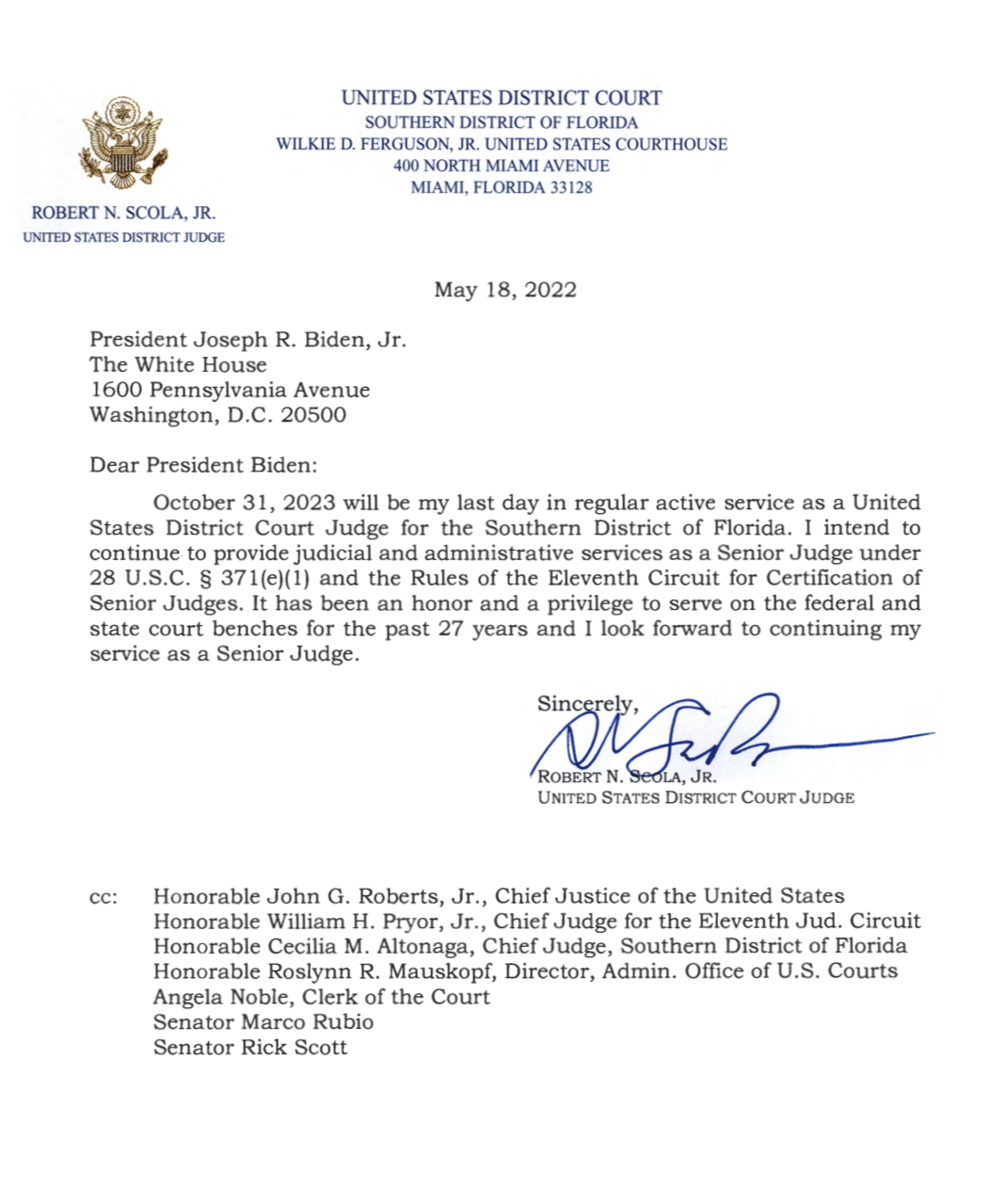
Judge Scola to take senior status in October 2023

Judge Scola is the best. I’m truly happy for him but sad for all of us. He was always fair, smart, and thoughtful. The perfect judge. 

At least we keep him till October 2023. Let’s see if the White House can get its act together and get some judges confirmed  


Sunday, May 22, 2022

Sentencings

I've often written about how our criminal justice system coerces pleas.  One of the reasons is the trial tax.  If you go to trial and lose, your sentence is likely to be many many times the plea offer -- sometimes more than a decade longer.  It's unjust.

Because there were almost no trials during the pandemic, and many judges were more compassionate during that time (it’s all relative), it was easy to forget about the awful trial tax in our system.

But recent sentences in our District and others are showing that there is absolutely no let up for the trial tax -- even for non-violent offenders. Most judges, who have never represented a criminal defendant, have no sense what a 5 *year* sentence does to a person, a family, a community. It’s completely devastating. 

One possible solution -- at a sentencing post-trial, judges should be told what the plea offer was.  If a plea offer was X, the government shouldn't be asking for 4X. 

Since COVID, prosecutors have also candidly told me that they are now asking for much higher than they believe is appropriate at all sentencings because they believe that most judges will vary down from their recommendation.  The typical scenario is that a prosecutor believes that a sentence of 10 years is warranted.  The defense believes 3 years is right.  The prosecutor knows that if both sides ask for those sentences, a judge is likely to give 5-6 years, so the prosecutor asks for 12 or 15 years in the hopes of getting 10.  Judges then feel like they didn't give the prosecutor everything they asked for, when they actually did just that.  

Anyway, that's my Sunday morning rant.  Sentences are on the uptick again post-COVID.  Incarceration rates are moving higher again.  While COVID remains, the compassion during the pandemic seems to be fleeting.